Hi Josh,
This is a great thought experiment, and it goes straight to the heart of how least squares multi-sight reduction works in practice.
Looking closely at your table, I spotted your very understandable simplification: you set this up with a fixed declination of South 3 degrees 01 minute and stepped the local hour angle forward by an exact 15 degrees per hour. When running sights through the USNO 1999 multi-sight matrix engine on my handheld navigation computer, the software evaluates the real physical ephemeris dynamically. Over an afternoon run of nearly two hours, the true Sun declination and hour angle drift naturally, so my figures reflect that physical sky, and I introduced a realistic observational scatter of around one nautical mile.
The short answer to whether quantity beats quality is that it depends entirely on which axis of your position error you inspect.
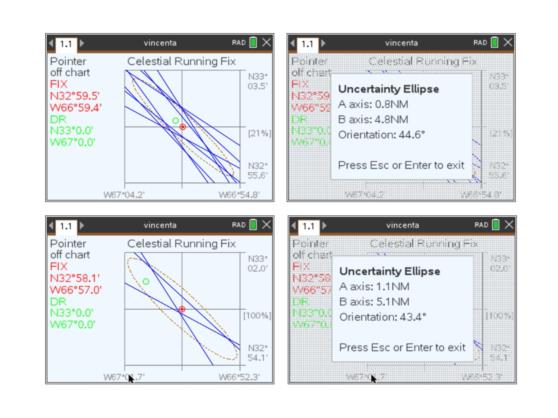
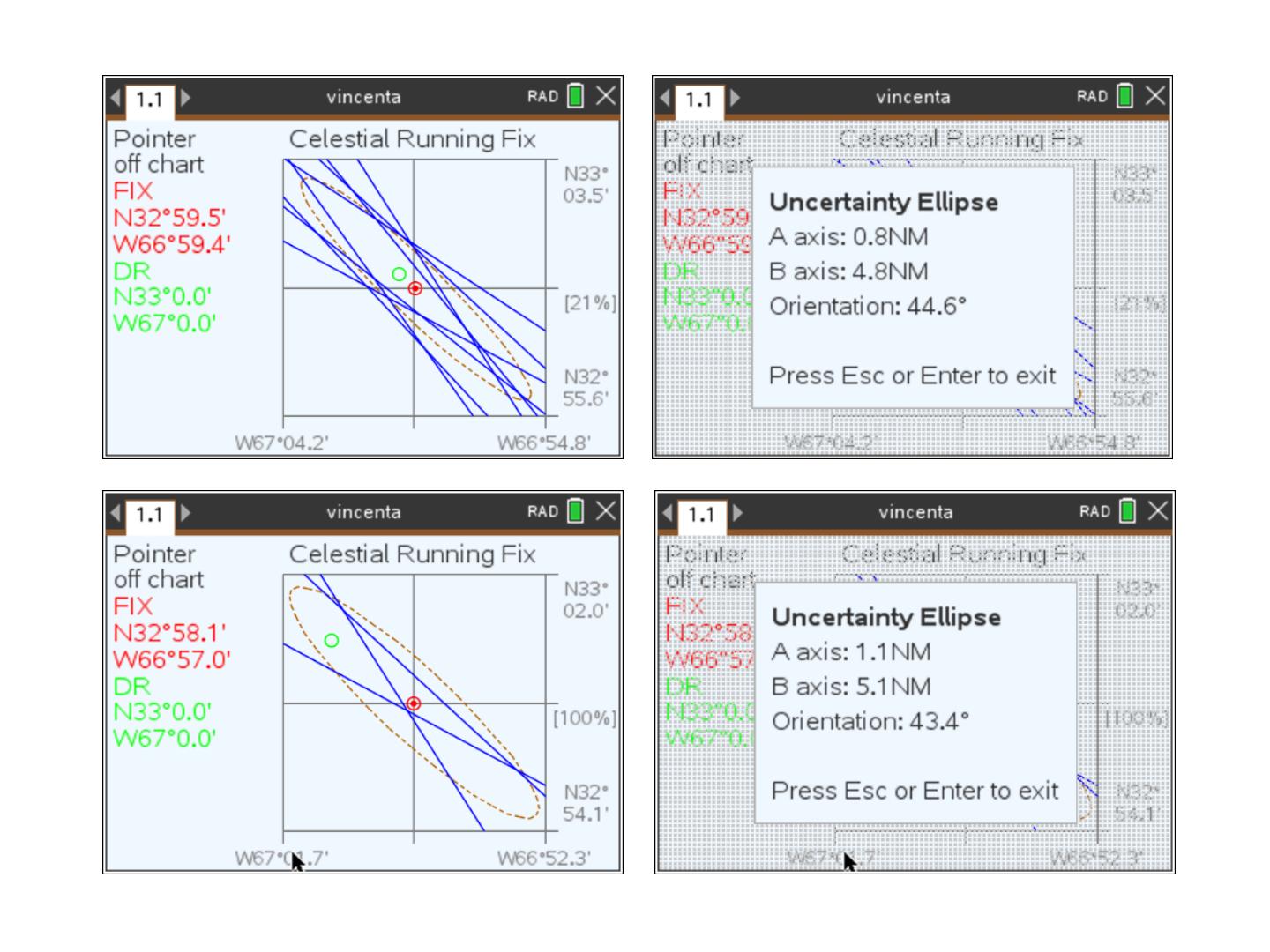
To demonstrate this, I ran your problem through the USNO solver in two configurations, and I have attached a four panel image to illustrate the comparison:
First, I ran all eight sights together. In the top left panel, you can see the full fan of eight position lines spanning 29.3 degrees, with the central fix and the confidence ellipse drawn around the intersection cluster. In the top right panel, the dialog shows the exact ellipse dimensions: the minor A axis is 0.8 nautical miles, the major B axis is 4.8 nautical miles, and the orientation of the A axis is 44.6 degrees.
Next, to see what all those extra shots in the middle actually contributed, I ran the fix using only three sights: the first at 17:30, the middle at 18:30, and the last at 19:15, covering that exact same 29.3 degree spread. I could not use just two sights because two sights have zero degrees of freedom, which yields an exact intersection point with no residual uncertainty ellipse. Three sights provide the necessary redundancy for an honest least squares ellipse with one degree of freedom.
In the bottom left panel, you can see the three position lines forming the classic triangular cut. In the bottom right panel, the modal dialog displays the three sight ellipse: the minor A axis is 1.1 nautical miles, the major B axis is 5.1 nautical miles, and the orientation of the A axis is 43.4 degrees.
Comparing these two runs reveals the exact geometric trade off:
Look at the orientation first. In both cases, the A axis orientation of roughly 43 to 45 degrees points along the line of bearing to the Sun. Every sight measures your distance from the Sun directly across the position lines, which is why your position in that direction is tightly pinned down, giving a minor A axis of only 0.8 miles.
The weak direction is the orthogonal line, running along the length of the position lines from Northwest to Southeast (roughly 135 to 315 degrees). Because the lines cross at such shallow angles, any small observational error causes the intersection point to slide. That is why the major B axis stretches out to 4.8 miles.
At first glance, looking only at where the point fixes landed, one might assume eight sights solved the along track problem, because the eight sight fix landed only 0.7 miles from the DR, while the three sight fix slid 3.1 miles down the line to the Southeast (N 32 58.1, W 66 57.0). But that closeness to the DR is simply because the random noise across my eight sights happened on average to be zero, balancing out near the centre.
If random errors do not cancel out so neatly, as happened in the three sight case where a slight net bias remained, the shallow geometry magnifies that small error and sends the fix sliding down the corridor. Hence, the true navigational reality is revealed by the size of the uncertainty ellipse itself. In both runs, that long corridor barely changed at all, dropping only from 5.1 miles down to 4.8 miles. The solver is warning the navigator that on any given day, an eight sight fix can still easily drift two or three miles down that corridor, because the angular cut is simply too narrow to shorten the hallway of uncertainty. Adding extra sights increases the probability of landing near the middle, but it cannot shrink that five mile corridor until the Sun travels across the sky.
Across the lines, however, quantity definitely won, tightening the minor A axis from 1.1 miles down to 0.8 miles.
The takeaway for your story is that packing extra sights close together gives tremendous confidence, averages out random human errors, and stops your fix from sliding wildly. But when it comes to shrinking the actual length of that uncertainty corridor, quantity cannot replace waiting for the Sun to travel and give you a wider cut.
Marco Suadoni
River Moth (Nauticat 33), Essex, UK
www.vincenta.co.uk
File: