NavList:
A Community Devoted to the Preservation and Practice of Celestial Navigation and Other Methods of Traditional Wayfinding



From: Matus Tejiscak
Date: 2026 Jun 7, 10:38 -0700
Nice puzzle, thanks.
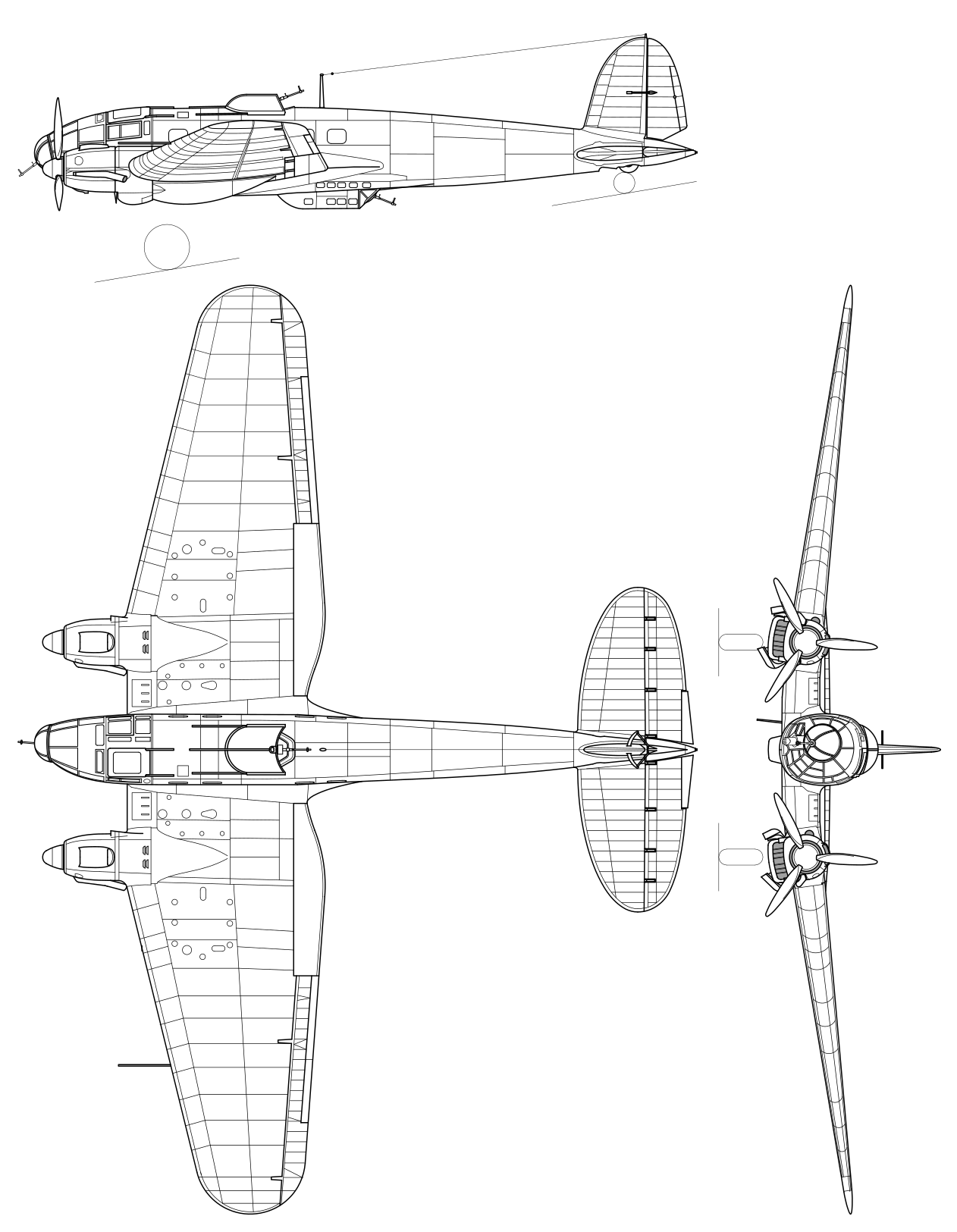
Wikipedia has some very useful information (such as the wing span of 22.6 m) and a nice SVG drawing of the aircraft. I loaded it up in QCAD and after setting the right scale, I can conveniently measure the distance between any two points of the plane. Specifically, its length is about 16.1 m (excluding the pointy bit protruding from the front). A bit of an overkill for this purpose but I originally thought I'd be measuring some arbitrary lines to reduce the projection distortion.
I loaded up the photograph in FIJI, which is a program that lets you draw a line between two points and gives you a plot of the pixel brightness profile over the pixel distance along the line. It's not always clear but most attempts along lines parallel with the fuselage yield a penumbra width of about 25 px. The apparent length of the shadow of the fuselage is about 198 px.
If a 16.1 m fuselage casts a 198 px shadow, then a 25px penumbra corresponds to about 2 metres at an unknown projection distance. Since the apparent (angular) size of the penumbra is equal to the apparent angular size of the Sun, which at this level of precision is half a degree, the projection distance is about 230 m. But that's not the altitude of the plane. And it's not even the _real_ projection distance.
Since we're looking from the thing that casts the shadow, we'll always see the penumbra half a degree wide, whatever the terrain underneath. If the terrain is sloped, the shadow will be longer on the ground but the projection into observer's eye will always undo the distortion of the shadow so the terrain cancels itself in the equation. However, the fact that the (axis of the) fuselage is not perpendicular to the Sun's rays does make its shadow shorter, and thus make the projection distance appear longer than it really is (without affecting the penumbra). I don't know how to measure that tilt but we can try a couple of estimates. Eyeballing the picture and assuming level flight, I'd guess a 30° zenith distance of the Sun, which amounts to about 200 m true projection distance, and 170 m of altitude. A more likely ZD of Sun in southern England would be, say, 45°, which yields about 120 m of altitude. Higher ZDs don't seem very consistent with the picture to me. Moreover, the fuselage projection angle will likely be smaller than the zenith distance but I'm neglecting that because we're now in the ± 15° territory, anyway.
So I'd guess about 150 m of altitude, which is a bit more than David Pike has estimated. I wouldn't be surprised if his guess was more accurate, though. Is the answer known?
Matus