NavList:
A Community Devoted to the Preservation and Practice of Celestial Navigation and Other Methods of Traditional Wayfinding



From: Frank Reed
Date: 2025 Nov 30, 08:57 -0800
Chris Post, you wrote:
"I just tried that with my Mark 15. Starting at 0°, 35 positive rotations of the micrometer got me to 35° exactly, with precise alignment at each degree. I reset the index to 70°; 35 negative rotations got me to 35° with the same precision."
Thank you so much for doing that. There's another way to see that this should be the case on a properly designed sextant. If I set the sextant to exactly 0°00.0', and if index error is minimal, then the primary index arm pointer will be aimed right at zero (visually, a difference of 3-5 minutes of arc in this 'degree pointer' should be readily apparent by small adjustments of the micrometer). Next, if I release the worm gear (by squeezing the calipers) and move the arm to some other random angle location on the arc (30°, 45°, 70°, etc.), when I release the calipers and allow the worm gear to seat in the grooves on the rack, then, assuming I haven't turned the micrometer, the alignment between the 'degree pointer' and the degrees on the arc should still be exact. If it's not, that's trouble. If it's different at every degree, then there is a substantial problem, as in this Fake Tamays. (but note that there can also be a small consistent offset, which is not a problem... see PS).
Fundamentally, the scale on the arc and the grooved rack under the arc should be carefully aligned in a modern micrometer sextant. Yet here's something surprising: in a way, we don't need the scale printed on the arc at all! Imagine erasing it... You could even build a sextant with a micrometer 'knob' that displays a continuous count of degrees and minutes. It would have no visible arc and no scale of degrees on the arc (someone please take the hint and give an example of an instrument like this).
Consider a common marine sextant. If I pretend the scale on the sextant arc doesn't exist, I can begin my sextant observations every time with an 'index zero' test: I squeeze the calipers to release the worm gear, aim at the horizon, and then slide the arm until the horizon appears on both sides. Release the worm gear and let it seat properly. Now carefully turn the micrometer until the two sides match up (no 'step' in the horizon, as usual). Check and record the micrometer reading (to be specific, let's suppose it reads 13'). Next preset the sextant to the nearest degree, rounded down, by counting off exact, full rotations of the micrometer (let's assume it's a Noon Sun sight with a good estimated latitude of 41° so I can pre-calculate the meridian altitude from (90°-Lat)+Dec -- today at 41°N and near 71°W that would be 27 turns). I carefully turn the micrometer counting off 27 complete rotations... Now I look through the instrument and adjust until the Sun is sitting on the horizon. I read the micrometer, and it says 38'. But from my original micrometer offset in the index zero test at 13', that implies 25'. The final observed altitude is 27°25' ...with no scale on the main arc.
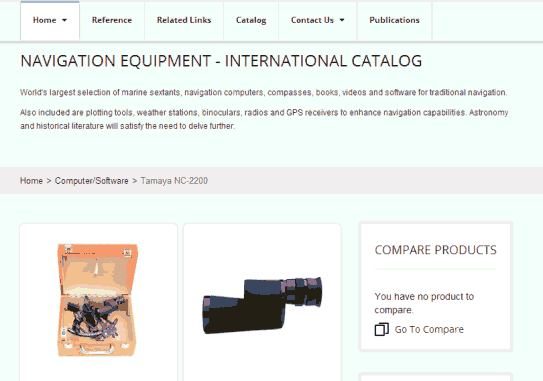
On this "poor" sextant, the Fake Tamaya, the scale on the arc has been disconnected from the milling of the rack on the arc. This milling is itself suspect, and clearly there is no sense in which one is right and the other wrong from the testing so far. All we know right now is that they don't agree. They don't agree, and that would lead to weird errors. If the errors were small, let's say only a few minutes of arc at different points on the arc, then this would be managed as a straight-forward "arc error" and it could be listed on a sextant certificate. But with errors amounting to several degrees, that would become very difficult. In addition, there is likely additional arc error from other sources which we have not yet assessed. Applying sextant corrections of several degrees at each possible altitude on the arc would make the sextant exceedingly difficult to use in practice even without its other serious problems.
Please, all of you, try to think of other features that we might test. I have a plan here that I think could have a useful impact in the wider sextant marketplace. I intend to post this sextant on eBay with a detailed description explaining what it is (a misleading, poorly manufactured copy of a sextant), and what it is not (it is not —not even remotely— fit for navigation). I will price it somewhat above the usual selling prices for these "Fake Tamaya" things and with somewhat higher than normal shipping charges. It should appear in the "also listed" sections when potential buyers search for sextants, and at least some of those future navigators will read the description and learn to avoid the seduction of the Faka Tamaya.
Frank Reed
PS: We rarely pay attention to the exact position of the crude 'degree pointer' on the index arm and the degree lines on the main scale, but sometimes this can be a problem even for a properly adjusted, high-quality sextant. For example, you might have your sextant set to 23° and change... You rotate the micrometer until it's right at 00.0'. Then you notice that the 'degree pointer' is offset about half its width (a fraction of a degree) to the right of 23°. Do you worry? Not usually. You can become accustomed to that. But suppose the offset is much larger so that the degree pointer ends up halfway between 22° and 23° when the micrometer reads 0'. That could be a problem. It doesn't happen often, but this is a case where we need to make an unusual adjustment. The micrometer drum itself can be released from the 'axle' of the worm gear. On some sextants, there is a plainly visible screw at the outer end of the micrometer, in line with that 'axle' of the worm gear. On many sextants, there is a little cover that has to be pried off (it's easy enough with a knife edge) and then you find the screw underneath. Loosen this screw until the micrometer drum turns freely, no longer moving the worm gear. Then tighten the screw when the orientation of the micrometer looks like a good match to the apparent position of the 'degree pointer' on the main arc. Also note that this little screw attaching the micrometer drum to the worm gear sometimes comes loose all on its own. If you encounter a sextant where rotating the micrometer seems to do nothing (I have seen this several times in the past ten years), that is probably the cause, and tightening the screw will fix it.