NavList:
A Community Devoted to the Preservation and Practice of Celestial Navigation and Other Methods of Traditional Wayfinding
Re: Fix by Occultations
From: Brad Morris
Date: 2009 Feb 5, 10:22 -0800


From: Brad Morris
Date: 2009 Feb 5, 10:22 -0800
The reduction by occultation is definitely more difficult than the Latitude by
Double Altitudes, 4th method.  I have the first four Double Altitude methods
fully functional and some are quite tricky when applying the rules and cases.

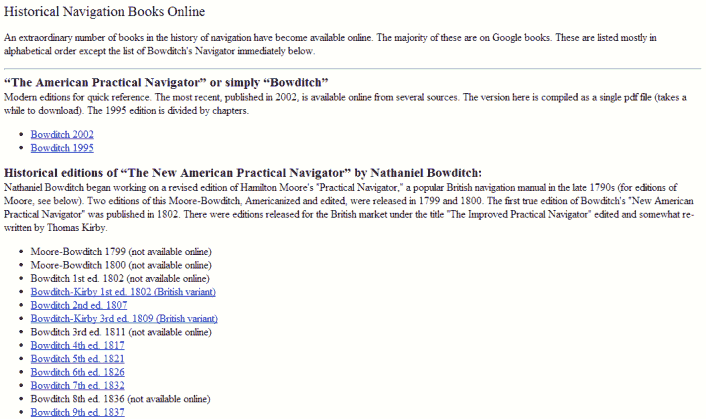
I have been playing with the Occultation reduction as given by Bowditch, 1849.
 It is spectacularly cumbersome.  For example, he indicates that we should
get the latitude and longitude of the moon from the Nautical Almanac.  These
terms are not explained elsewhere in the Navigator nor provided in the
current Nautical Almanac, so what is the student to do?  Woodhouse, "A
Treatise on Astronomy", 1823, explains that these are the heliocentric
coordinates of the moon.  My conversion of the Moon's GHA from the NA to the
heliocentric latitude and longitude takes 40 rows in an excel spreadsheet
(step by step, I am sure this can be minimized).  I cannot prove the
conversion yet, but that's just one example!  I have parts of the occultation
reduction, but as of right now, cannot complete it.  This remains a
fascination!

Woodhouse further provides a wonderful explanation of the determination of the
longitude.  I will summarize his comments.  There are two classes of
reductions.  The first is absolute time method, where all observers on the
planet see the event at the same time.  The second is the "reckoned" time
method, where observers on the planet see the same event at different times.
Woodhouse explains that the first method can be performed by simple reduction
but yields in-accurate results.  The second method suffers from tedious
reduction but "great exactness" in result.

1)  Longitude by Chronometer.  Absolute time method. Cannot be relied upon, as
the rate of a chronometer will change as a function of the environment.
Problem can be alleviated by the use of multiple chronometers.  Remember,
Woodhouse wrote in 1823!
2)  Longitude by Eclipse of the Moon.  Absolute time method.
3)  Longitude by Satellites of Jupiter.  Absolute time method. States that
Nautical Almanac of the day demands a certain power of telescope, as the more
powerful the scope, the later the immersion and the earlier the emersion.
NavList discussion of this very issue exists.  Unfortunately, he does NOT
give the power of the scope.  I would love to try this method someday.
4)  Longitude by Lunars.  Reckoned time method.  We all have fun with this one!
5)  Longitude by passage of the Moon over the Meridian. Reckoned time method.
Land only (observatory) method.
6)  Longitude by Eclipse of the Sun.  Reckoned time method.
7)  Longitude by Occultations.  Reckoned time method.  States that this is
more accurate than solar eclipse.  More accurate than Lunars.
8)  Longitude by Transits (of Venus and Mercury).  Reckoned time method.

{Forgive me if I got this wrong, but I am sure the list will correct me! :-) }

If Chauvenet states that a navigator CAN see the occultation at sea, then we
should not doubt him.  Some of the Woodhouse's methods are land navigation
only, but I do not think that is prohibited on the list.  I would like to
think that this list would be interested in the honors program of navigation.
Tally-ho!

Best Regards
Brad


--~--~---------~--~----~------------~-------~--~----~
Navigation List archive: www.navlist.net
To post, email NavList@navlist.net
To , email NavList-@navlist.net
-~----------~----~----~----~------~----~------~--~---