NavList:
A Community Devoted to the Preservation and Practice of Celestial Navigation and Other Methods of Traditional Wayfinding



From: Frank Reed
Date: 2026 Apr 10, 09:58 -0700
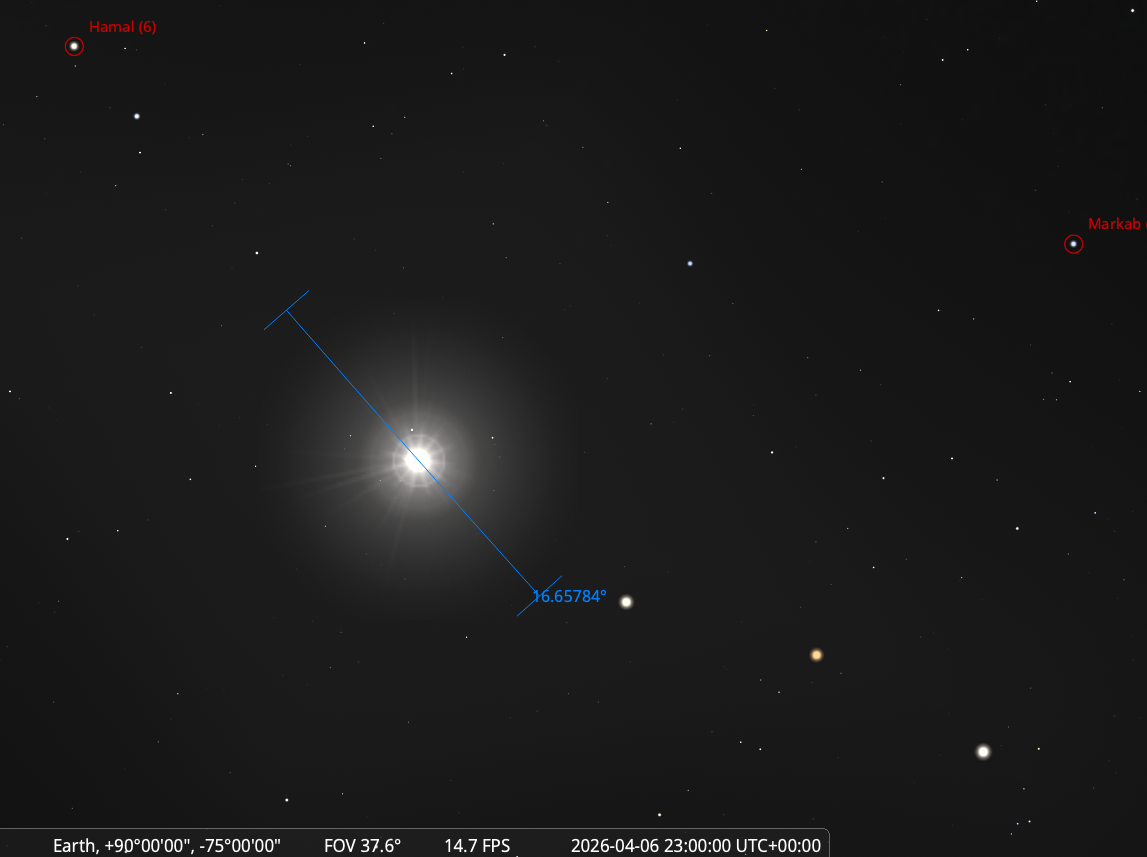
This one is relatively easy to simulate. We know where the Sun is in the photo --behind that mysterious black hole! And we know the date within a day or so... even better if we look up the mission timeline.
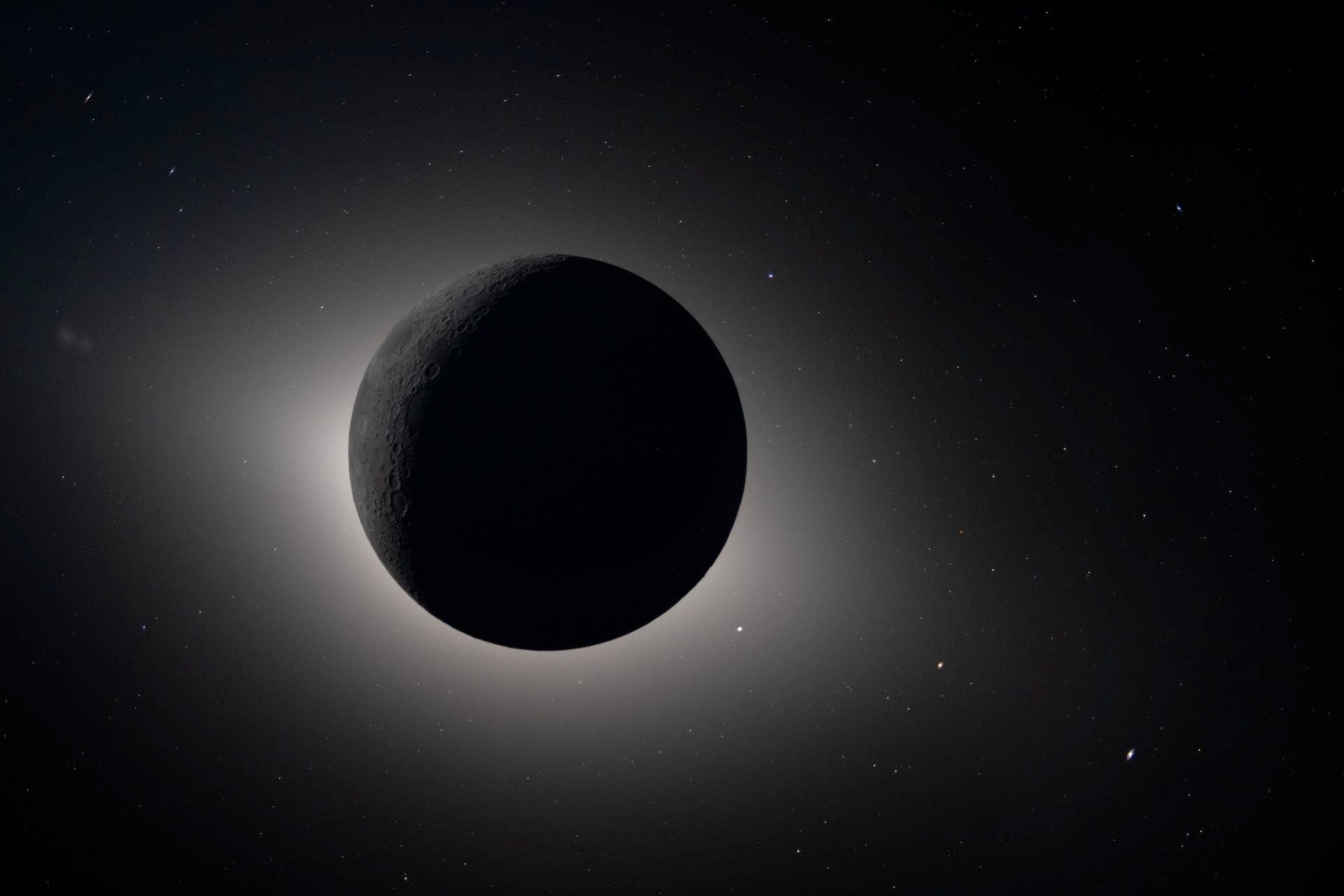
Key features: the three bright "stars" toward the lower right are the planets Saturn, Mars, and Mercury, from left to right. The planet Venus would have been brilliant, and we can see a hint of it just out of the frame of the image on the left. There's a pair of camera "flares" (apparently) that look like smudges toward the left. They're pointing at Venus. We also have two official navigation stars (official meaning found on the list of 57+1 in the Nautical Almanac). Hamal and Markab are highlighted as shown by the "Navigational Stars" plugin in Stellarium.
In this simulation, I set the date and time to put Mars in the right spot relative to faint stars near it. There's a small trade here between parallax and time, but I ignored that (it's not large). I also added an angle bar to show a rough estimate of the angular diameter of the Moon. It's about 32x times bigger than its average size as seen from Earth. That implies that the Artemis astronauts were about 32x closer to the Moon (center of the Moon) than the earth-based average distance, so they were about 6700 nautical miles away from the Moon's center.
The part of the Moon illuminated on the left in the photo is a portion of the Moon's "near side" peaking around. That portion would have been visible from Earth at the very time this photo was taken. We know that because it's illuminated here by "earthshine".
Another question: what is the faintest star visible in this photo? This is a little tricky because we have to use the true "above the atmosphere" magnitudes. Does the image correspond well to the natural "naked eye" view the astronauts would have seen? I think it's at least relatively close.
There's navigation in this photo, too. On the Apollo missions, it was imagined that the astronauts wouls shoot "Space Lunars" with the sextant built into the Command Module (not really applied for practical navigation). Today we can achieve the same goal with digital photography, like this image. The stars in the field around the Moon tell us the exact direction --on the celestial sphere-- to the Moon's center. The angular size of the Moon gives a good measure of distance from the Moon, when measured properly. So we know the spacecraft's location in three-dimensional space relative to the Moon. One might complain that this can't be done without computing power, but that was also true in the Apollo days... no computer, no navigation.
This beautiful image, by the way, reveals one big change from the Apollo spacecrat. They gave the astronauts excellent windows to enjoy the view!
Frank Reed