NavList:
A Community Devoted to the Preservation and Practice of Celestial Navigation and Other Methods of Traditional Wayfinding



From: Trammell H
Date: 2026 Jul 1, 09:19 -0700
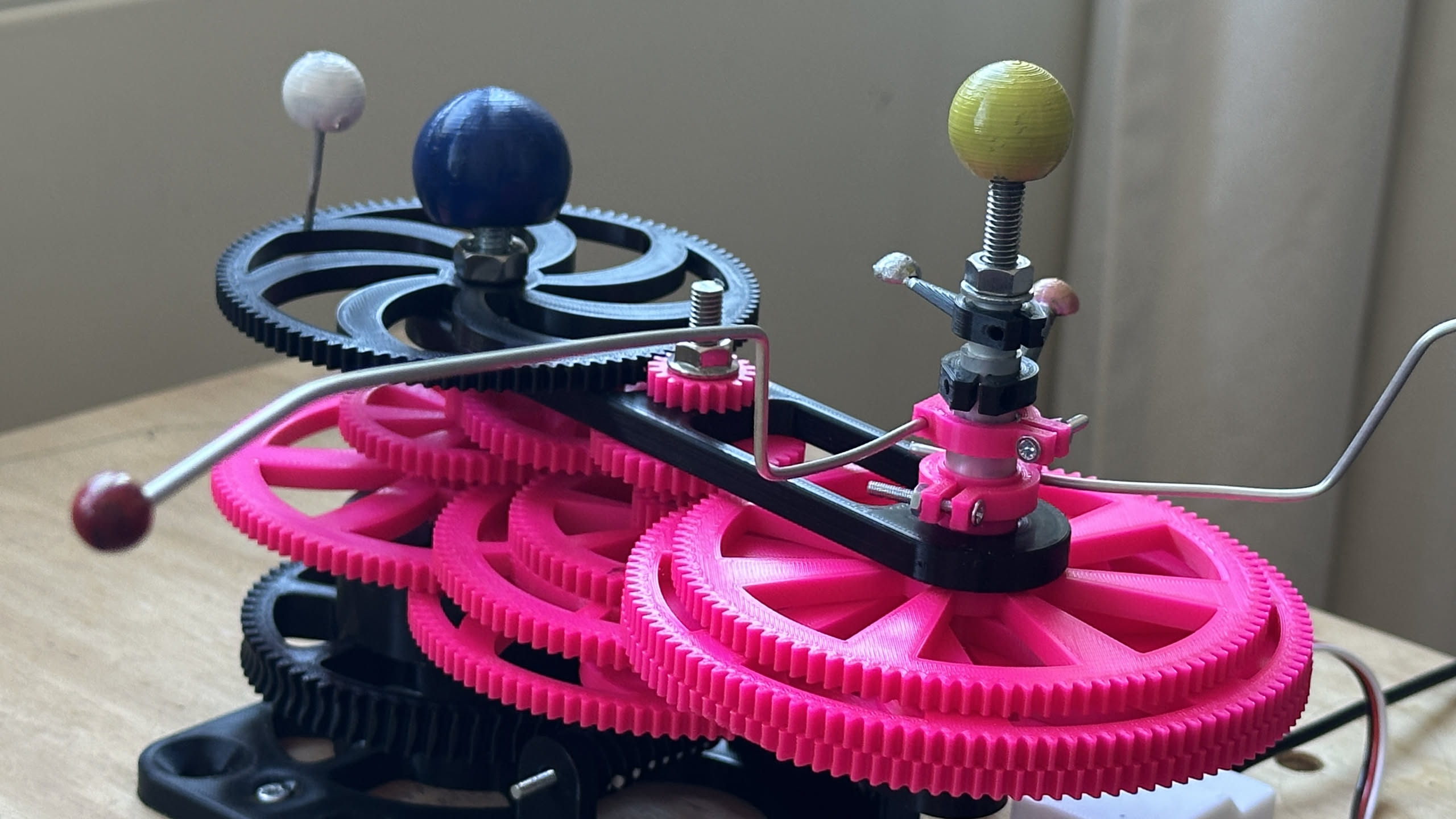
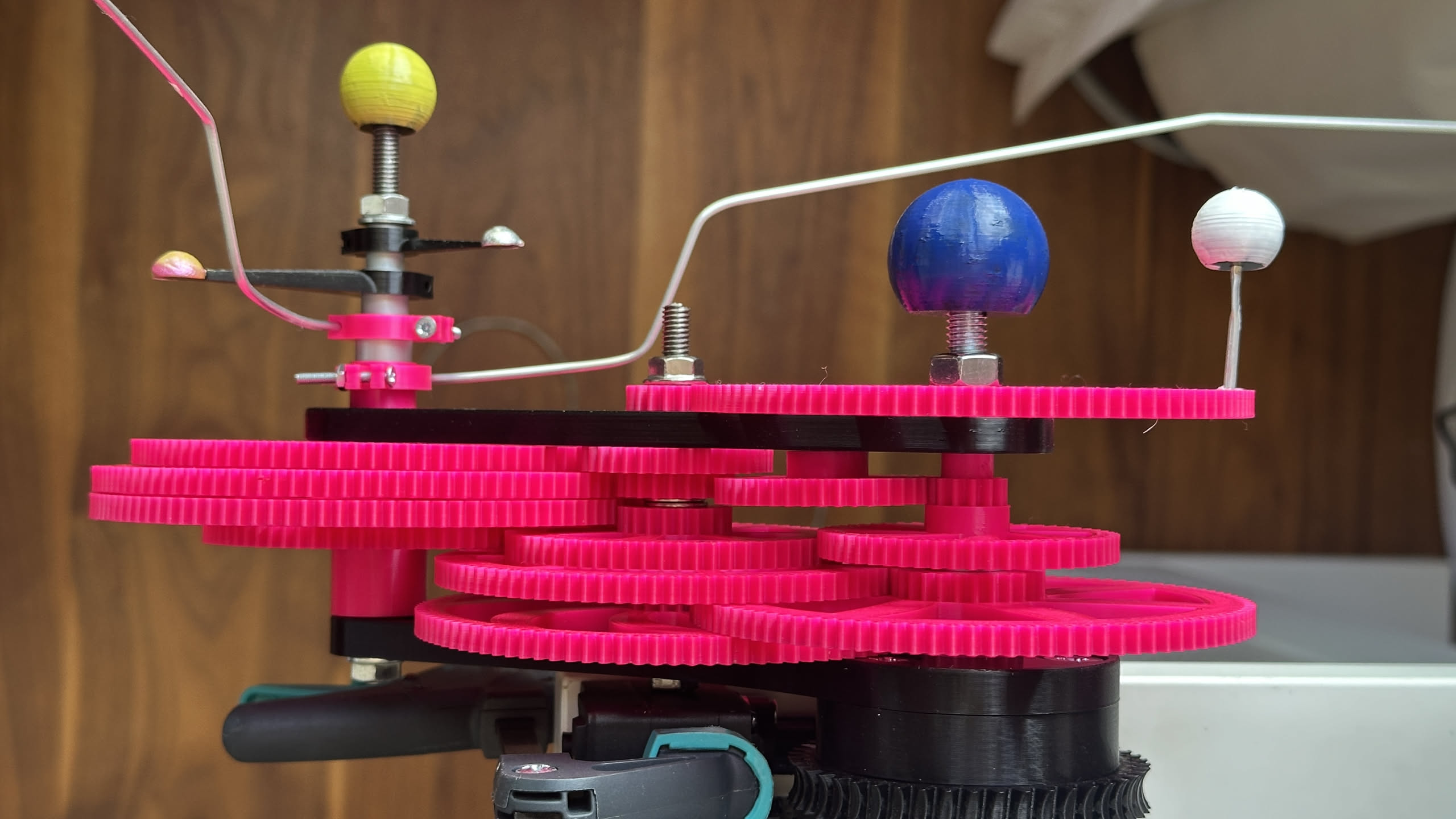
I love orrerys, although it has always bothered me that they put the Sun at the center and as a result it is hard to use them to find planets in the sky. So I designed a geocentric one that puts Earth back where it belongs, fixed in the center of the solarsystem. The Sun rotates around the stationary Earth once per day, dragging the planets with it, and the moon slightly lags behind by 12.19° per day, so when I hang it from the ceiling everything will line up with their actual azimuth to the horizon. Now if I'm wondering "what planet is that?" I can compare the position in the sky to the orrery and immediately see if it is Mercury, Venus, Mars, Jupiter, the Moon or the Sun. Usually I don't have a problem recognizing the last two, but including them helps me visualize the phase of the moon.
You can see a timelapse of a single day https://social.v.st/@th/116833325936522429 along with some in-progress photos on my mastodon account.
With the exception of the servo motor, axles and some screws, it is all 3D printed and designed in FreeCad. The sources are here https://github.com/osresearch/geocentric
I'm working on a full writeup about the epicyclic gear math and the search technique for finding integer gear teeth combinations that share a common total while producing a ratio very close to the synodic periods of the planets. This results in a small number of axles that are shared between all of the gears and makes a relatively compact geartrain, despite only having a fraction of a percent error for everything except Jupiter (which will need a slight position tweak every two or three years).