NavList:
A Community Devoted to the Preservation and Practice of Celestial Navigation and Other Methods of Traditional Wayfinding



From: Tom M. Patrick
Date: 2026 Jun 5, 11:36 -0700
Following your lead, Josh...
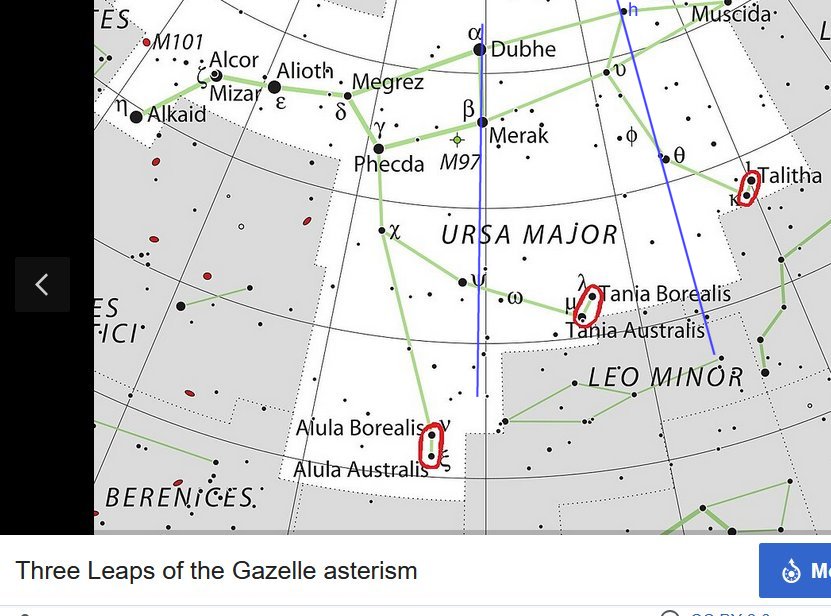
I looked at that star chart and found two pairs of stars with the same RA (or SHA). See my image, attached. The first pair stars are Dubhe and Merak. Those are the pointers in the Dipper. We can't use them. In the photo those are *NOT* aligned vertically so they are not on the meridian. I noticed another pair. The stars "theta" U. Major and "h" U. Major have almost the same RA, and they are aligned veritcally in the photo. Yee-haa.
For scale I measured the pixel separation from "theta" to "iota" U. Major (that star is Talitha or Dnoces and it's in one of those "three leaps" that Frank Reed mentioned). The scale I computed is almost exactly 22.0 pixels per degree. Then, as nearly as possible I measured the "sextant height" of theta as 22.16 degrees by counting pixels to the horizon and using my scale. I decided to subtract 0.2 degrees for a guess on height of eye and refraction correction. Sound reasonable?
My corrected altitude for the star is 21.96. The declination (from Wikipedia for the theta star) is 51.67 so the PD (=90-dec) is 38.33.
And finally Lat=PD+Ho=60.29. That's almost identical to yours, Josh.
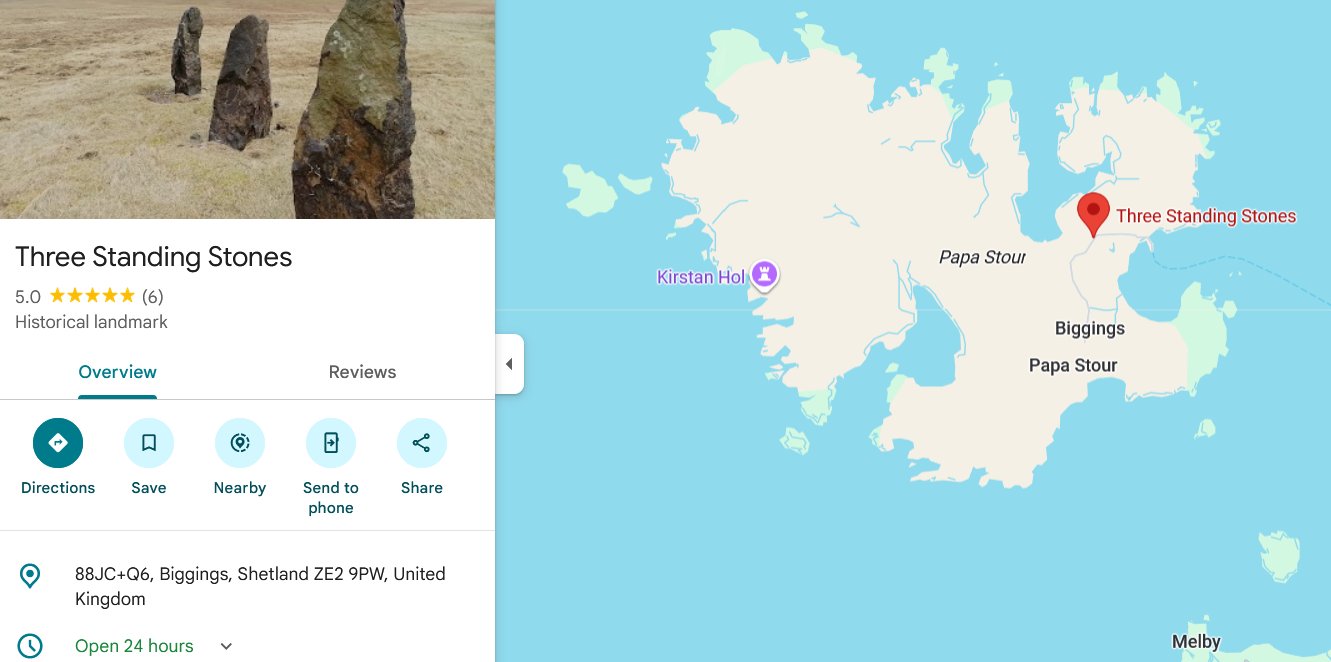
Frank limited the longitude in that first post to the band west of Norway and east of Greenland, and there's nothing at that latitude, 60.29, except the Shetland Islands.
IT GETS BETTER! Look what I found just a few miles north... Something called "Three Standing Stones". A sort of unfinished Shetland Henge maybe? I couldn't find anything more about it.
Tom