NavList:
A Community Devoted to the Preservation and Practice of Celestial Navigation and Other Methods of Traditional Wayfinding

Re: Linux/UNIX Almanac Generator And Sight Reduction
From: Paul Hirose
Date: 2026 Nov 7, 12:59 -0800


From: Paul Hirose
Date: 2026 Nov 7, 12:59 -0800
> *From: *Diego Melas
> *Date: *2026 Nov 5, 23:05 -0800
>
> Ageton is attractive for the reason you give, one procedure for all
> bodies and two pages of table, but it has a failure mode that matters
> precisely for the user you describe, the one who does not practise the
> method often. When K approaches 90 degrees, sin K = sin Dec / cos R
> becomes ill-conditioned and the computed altitude can be wrong by tens
> of arcminutes. Nothing in the form warns the navigator: the arithmetic
> closes normally and the line of position is simply in the wrong place.
> Ageton's own answer was to avoid those sights.

I believe that danger will not escape those with mathematical common
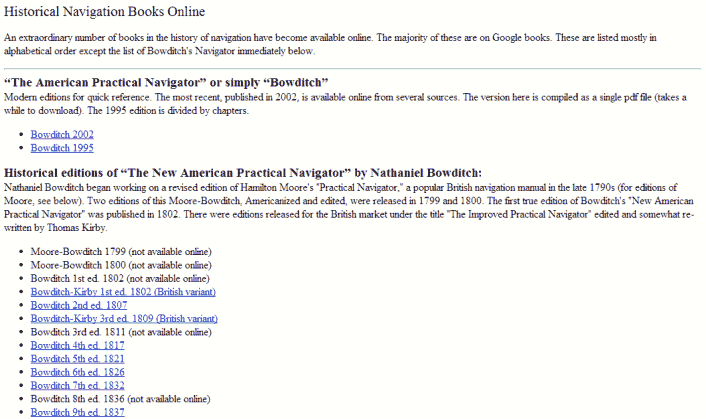
sense. For instance, see the example in Bowditch vol. 2 (1981) p. 574:

https://archive.org/details/americanpractica0002nath/page/574/mode/1up

Here A = 7, which we look up in the Ageton table

https://archive.org/details/americanpractica0002nath/page/369/mode/1up

and extract the corresponding angle K = 88 56. But obviously A is
insensitive to angle in this range. It varies by only 0.1 between
adjacent table entries. Nevertheless, my Hc calculated with vectors is
only a tenth minute different from the example.

Bowditch says, "When the quantity K is between 82 and 98, it is good
practice to discard the sight or to interpolate log secant (B) of R from
the log cosecant (A) of R." I'm skeptical that will gain much accuracy,
but have never tested it.

For such cases the Davies variant on the Ageton table offers an
alternative solution, which he credits to D.H. Sadler. (This is from
memory. I have Davies in hard copy, but getting to it would require some
excavation among my books.)

--
Paul Hirose
sofajpl.com