NavList:
A Community Devoted to the Preservation and Practice of Celestial Navigation and Other Methods of Traditional Wayfinding

Lunar longitudes, not by lunar distance. Was- Re: Working a lunar
From: George Huxtable
Date: 2009 Aug 7, 10:36 +0100


From: George Huxtable
Date: 2009 Aug 7, 10:36 +0100
I've altered the threadname, to reflect a change in direction of this
discussion.

First, an apology. I mentioned William Baffin's unsuccessful attempts at
longitude, by the Moon's southing, as being 40 years earlier than that of
James, which was made in James Bay, in the winter of 1630-31. That was quite
wrong. There's an interesting piece by Tony Crowley about Baffin in the
November / December 2006 issue of Navigation News (the RIN's
more-lightweight publication, if set alongside their Journal of Navigation),
which puts Baffin's attempt as 1612. He points out that if Baffin's
arithmetic hadn't been erroneous (or fiddled, I wonder?), his observation
would have put him somewhere in the Ural Mointains!. Incidentally, Crowley
mentions that "...on later voyages, his attempts to find his longitude were
more successful, and he seems to have acquired a better understanding of the
Moon's relative motion." That's new to me; can anyone offer details about
it?

One of Baffin's bugbears was the useless (for his purpose) ephemeris by
Searle. Ephemerides,  in those days, were compiled mainly for astrological
purposes, and were hopelessly inaccurate in predicting Moon positions.
William James was no better off in that respect, but got round the problem
by cooperating in advance with Gellibrand, a London astronomer, who agreed
to time Moon meridian passages from London whenever a clear sky allowed it.
By comparing their results, on James return, they became independent of the
vagaries of predictions.

James was certainly well-equipped in his planning for the observation. He
had put a couple of lofty poles in the ice, so that a long rope line
stretched between them became his transit line across the sky for an
observer sitting below with a fixed eye-position. He damped out any
vibration that wind would cause, by attaching vertical ropes at intervals
along the length of that line, as in a suspension bridge, carrying suspended
weights. Those verticals were adjusted in length so that the weights dangled
in pits, specially dug in the ice, which were filled with water to provide
the damping. Presumably that water would subsequently freeze, which would
then be of no consequence; its purpose had been served.

Fortunately, at the time James made his observation, the London sky had been
clear enough for Gellibrand to observe his lunar transit a few hours
earlier. Otherwise, the whole operation would have been wasted. A stroke of
fortune that James richly deserved, in my view, for his clear thinking and
meticulous planning with Gellibrand. He doesn't seem to have achieved much
recognition for that achievement.

==========================

Hanno wrote, in [9395],

BTW: I am finding a copy of this book from 1874 on Google Books. I'll
download it and see what Chauvenet has to teach us.

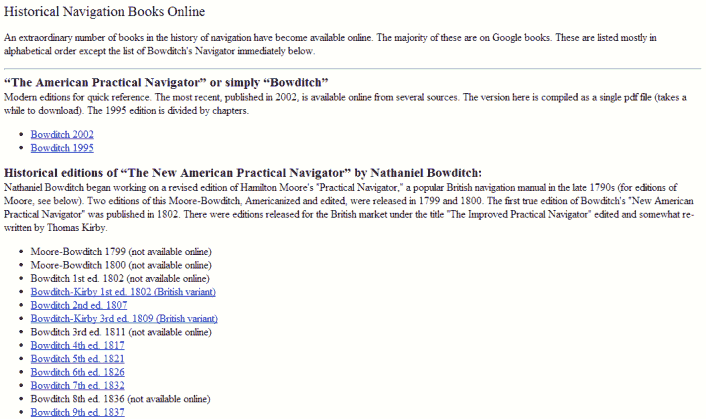
Good. Chauvenet's "Practical and Spherical Astronomy", in 2 volumes, is a
superb resource. I don't know of a single error to be found in it (which
doesn't imply there are none). Rather dry, mathematically thorough, very
comprehensive, and (meeting Hanno's interests) dealing with an astronomer's
requirements on land, perhaps rather more fully thatn the navigator's at
sea.

He offers 7 methods for determining longitude on land; also 5 from the sea,
which include chronometers, lunar distances, Jupiter's satellites (doubtful,
this one), Moon's altitude, and Moon occultations of stars. His on-land
methods include the electric telegraph, so he was highly up-to-date!

I can't speak for others, but my own preference, if possible, is to read
text as printed paper, rather than on screen, though I recognise digitised
books as a valuable resource. Fortunately, Chauvenet is available in many
forms, most recently in a print-on-demand version. It was published in a
Dover Books paperback edition some years ago, which can be found secondhand.
I haven't had either verion in my hands, but the original, in vol 2, had
several detailed engravings of astronomical instruments as large fold-outs,
and somehow I doubt whether they have been given the same generous treatment
in these later versions, which might be worth checking.

But I can't resist pointing to this pair I've found in Abebooks, bargain
copies, to my eyes, of an original printing of 1900 (it ran to many prints;
my edition is 1863). Copied below are the two Abebooks entries; prices in
pounds sterling as it's from Abebooks.uk. I don't object to ex-libary copies
of books, though some do. These sound as though they might benefit from a
bit of attention by a bookbinder, however. Again, it might be worth checking
on those fold-outs in vol 2.

=================================

      44.    A Manual of Spherical and Practical Astronomy Volume 2
      Chauvenet, William
      Bookseller: Stagolee's Variety
      (Brooklyn, NY, U.S.A.)
      Bookseller Rating:
     Price: £ 9.06
      [Convert Currency]
      Quantity Available:: 1  Within U.S.A.:
      £ 1.76
      [Rates & Speeds]

      Book Description: J.B. Lippincott, Philadelphia, 1900. Cloth. Book
Condition: Fair. No Jacket. Volume 2 : Theory and Use of Astronomical
Instruments. Blue cover has some fading and edgewear. Spine is loose but
strong. Endpages have typical library stamps and markings, but text and
illustrations are clean and unmarked.Ex-Library. Bookseller Inventory #
2003483


      45.    A Manual of Spherical and Practical Astronomy Volume 1
      Chauvenet, William
      Bookseller: Stagolee's Variety
      (Brooklyn, NY, U.S.A.)
      Bookseller Rating:
     Price: £ 9.06
      [Convert Currency]
      Quantity Available:: 1  Within U.S.A.:
      £ 1.76
      [Rates & Speeds]

      Book Description: J.B. Lippincott, Philadelphia, 1900. Cloth. Book
Condition: Fair. No Jacket. Volume 1 : Spherical Astronomy. Blue cover has
some fading and edgewear. Spine has rear cracked hinge, otherwise strong.
Endpages have typical library stamps and markings, but text and
illustrations are clean and unmarked.Ex-Library. Bookseller Inventory #
2003482
=============================

George.

contact George Huxtable, at  george@hux.me.uk
or at +44 1865 820222 (from UK, 01865 820222)
or at 1 Sandy Lane, Southmoor, Abingdon, Oxon OX13 5HX, UK.
----- Original Message -----
From: "George Huxtable"
To:
Sent: Friday, August 07, 2009 1:02 AM
Subject: Re: [NavList 9393] Re: Working a lunar - a PS


| Hanno seems to be re-inventing the method, described by Chauvenet in
| "Spherical and Practical Astronomy", (1863), as his 4th method for finding
| the longitude (by moon culminations). Also relevant is his 5th method, by
| azimuths of the moon, or transits of the Moon and a star over the same
| vertical circle. Both highly accurate when observed from on land, but not
| possible otherwise.
|
| Used for determining the longitude in the ice of James Bay, an appendix of
| Hudson bay, accurately by Thomas James, who overwintered there in 1630-31.
| This was the first successful use (that I know of) of lunar methods for
| longitude determination.
|
| As opposed to William Baffin, who is often credited with the first use of
| such lunar measurements 40 years earlier, but actually got it hopelessly
| wrong.
|
| There may be more to be said, but it's time for bed.
|
| George.
|
| contact George Huxtable, at  george@hux.me.uk
| or at +44 1865 820222 (from UK, 01865 820222)
| or at 1 Sandy Lane, Southmoor, Abingdon, Oxon OX13 5HX, UK.


| ----- Original Message -----
| From: "Hanno Ix"
| To:
| Sent: Friday, August 07, 2009 12:38 AM
| Subject: [NavList 9393] Re: Working a lunar - a PS
|
|
| Brad:
|
| Thank you for the time and thoughts you spent on this.
|
| We both agree that - if it worked - this approach to find position/GMT by
| the difference between the times of culminations, i.e. DT, is only
practical
| from land. But that itself would be rather desirable and probably quite
| within the technical means of a traveling ship.
|
| Frankly, I don't really know much about the kinematics of culminations of
| moving Heavenly Bodies. I suspect, though, that there might be significant
| deviations from a first order analysis. Even though these deviations might
| seem small for now, they might also end up a little cumbersome in practice
| because of the small size of the observed phenomenon itself - the movement
| of the moon.
|
| Nevertheless, the simplicity of the concept would make the approach
| attractive because it seems easy to understand and to remember. And
applying
| some corrections is a common part of celestial navigation. So, it might
| perhaps end up useful - if it is correct!.
|
| So, let's submit this concept to further critique of the group members.
|
| Thanks again and regards
|
| H


--~--~---------~--~----~------------~-------~--~----~
NavList message boards: www.navlist.net
Or post by email to: NavList@navlist.net
To , email NavList-@navlist.net
-~----------~----~----~----~------~----~------~--~---