NavList:
A Community Devoted to the Preservation and Practice of Celestial Navigation and Other Methods of Traditional Wayfinding

Re: Lunars
From: Henry Halboth
Date: 2004 Apr 6, 14:13 -0400


From: Henry Halboth
Date: 2004 Apr 6, 14:13 -0400
This is intended a a reply to George's comments and questions but, of
course, all are welcome to put their oar in. Hi ...

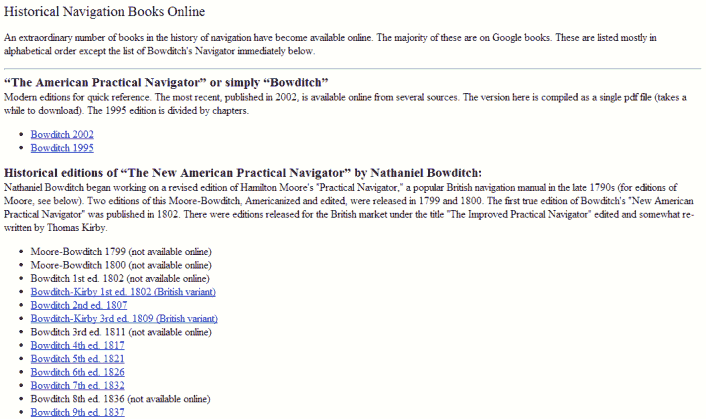
About 1942, I obtained the 1822 edition of the American Practical
Lunarian, authored by one Thomas Arnold, which proposed to instruct
aspiring navigators in the art of determining longitude by Lunar
Distance. This served to perk my interest, and later acquisition of the
1839 and 1898 editions of Norie's Epitome further served to get me on
track. Remember, at the time we had only celestial navigation to get from
A to B offshore - perhaps with a little help from the sounding machine
and RDF when conditions permitted, and I thought a knowledge of Lunars
might someday come in handy.

Brother Arnold advocated a short method of clearing the distance, which
he claimed to have invented and which smacks closely to that now
described as Kraft's versin method, as contained in Norie's Epitome, at
least the 1898 edition; as you know, the methods set forth to clear the
distance are myriad and beyond the purposes of this brief correspondence.
As respects any of my Lunars, I employed the various methods set forth in
Norie's 1898 edition to clear the distance, plus the tables provided
therein and those still published in the 1908 edition of Bowditch. There
is some small variance in the cleared distance, depending on the method
used, but this does not appear unacceptable.

During long, lonely watches in the South Atlantic, I occupied my time in
experimenting with such Lunar Distances as became conveniently available.
Although then aboard a medium sized ship, roll, pitch, and vibration were
a concern, as was the fact that, as a single observer bracketing
altitudes and interpolating them to the observed distance time was
necessary. My accuracy did mot seem to be much to brag about - as I
recall my longitudes were not much better than within about 15 minutes of
the truth which, based on my research at the time, did not seem too bad,
but far from any then standard of excellence - Norie allows that a 1
minute error in the distance equates to a 30 minute error in the
longitude, but that small errors in the altitudes are of no great
consequence. It is perhaps interesting to note that the 1839 edition
claims accuracy to "within a few minutes of a degree", a claim apparently
not repeated in 1898 and, which if true on a consistent basis at sea,
would have continued Lunars as of some practical worth.

As far as the true distance at Greenwich is concerned, I calculated the
same by Great Circle methodology for times to either side of my
observations. The whole business did not seem to be any small or quickie
calculation and would certainly have been expedited by even a pocket
calculator. I am well aware that the short tabular methods generally
provide for the great circle solution, but given the interpolation
necessary in working to the accuracy required in Lunars, I don't really
believe an experienced mathematical hand would select their great circle
methodology as any more convenient.

Most writers of my day, including Lecky, seem to have condemned Lunars on
the basis of accuracy and relegated them to the dustbin, although I have
questioned this disposition it seems that electronics, as well as the
unpopularity of the somewhat complicated theory, have served to complete
the burial. Regardless, on the basis of my experience, I would not be
prone to trust a position based on Lumar established longitude in making
a nightie landfall - unless the coast was extremely well lighted,
soundings in the approaches reliably charted, and my draft rather modest.
In other words, I would have a leadsman in the chains all night and the
lookout doubled, or stand-off until daylight. Oh gosh!, I forgot about my
radar so, for arguments sake, let's assume it to be "out of order" - but,
perhaps I'm living in the past - if we had electronics, why would we
bother about Lunars in the real world of today.

Please don't misunderstand. Lunars are a great topic of interest - and I
enjoy living in the past.

Regards,

                                Henry