NavList:
A Community Devoted to the Preservation and Practice of Celestial Navigation and Other Methods of Traditional Wayfinding



From: Frank Reed
Date: 2026 Apr 13, 00:06 -0700
Shane, welcome aboard! Measuring dip with a purpose-built device is a fascinating challenge. In some parts of the world, like in high latitudes among icebergs, anomalous refraction and dip can be a serious problem for navigation. Soviet navigators decades ago were advised to use their "dip meters" to measure that parameter.
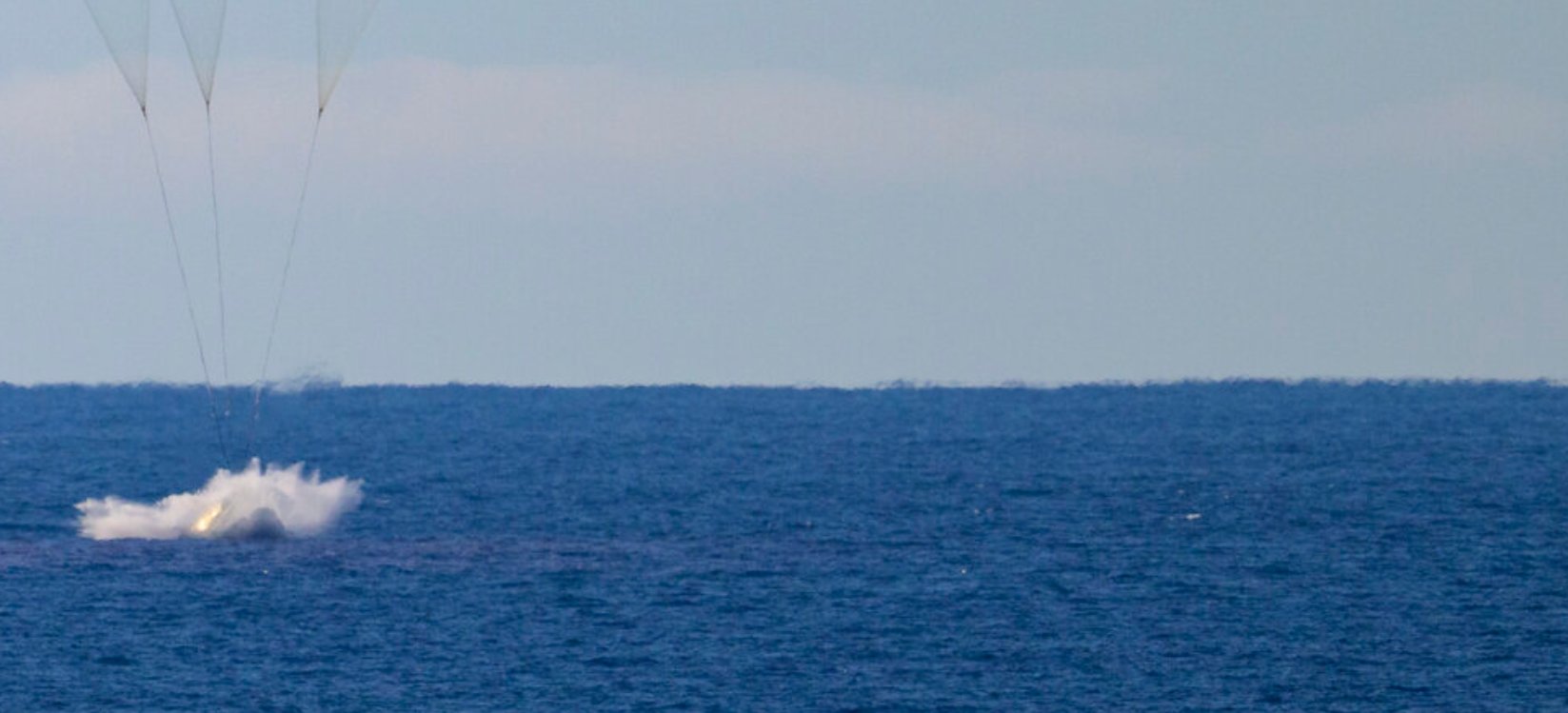
At a certain scale, anomalous dip can be more complicated than a simple measurement... If you photograph the sea horizon and zoom in enough to see details an order of magnitude smaller than a minute of arc, you'll often discover that the horizon is broken up into floating bits, flickering on and off as the local refraction conditions change... I call this "horizon confetti". It can evolve as waves rolling along the horizon. They're not water waves --they're waves of variation in refraction.
In this image of the Artemis splashdown recently, you can see some of that "horizon confetti". In this case it's even useful. The angular scale of that band of flickering horizon bits is typically around one-half to one minutes of arc. With the scale and the known physical size of the capsule, you can estimate the approximate distance to the capsule in the photo.
Frank Reed
PS: You asked if you had "run afoul" of any rules. No, not at all. But we do request that you use a name that includes either: first name and last name. or first initial plus full last name, or full first name plus last name initial. I assigned you a random surname initial, "A", here. Please email me with the correct letter (send to Frank@ReedNavigation.com). :)