NavList:
A Community Devoted to the Preservation and Practice of Celestial Navigation and Other Methods of Traditional Wayfinding



From: Frank Reed
Date: 2025 Nov 18, 10:37 -0800
David Pike,
First, I loved your half-ball analog model of the motion of the stars at the equator.
You added:
"Thesis: Standing at the Equator facing east the stars will rise from a horizontal angle north or south of east equal to their declinations. They will travel anticlockwise in a vertical semi-circle to reach a maximum altitude of 90°-their declinations and set towards a horizontal angle north or south of west equal to their declinations."
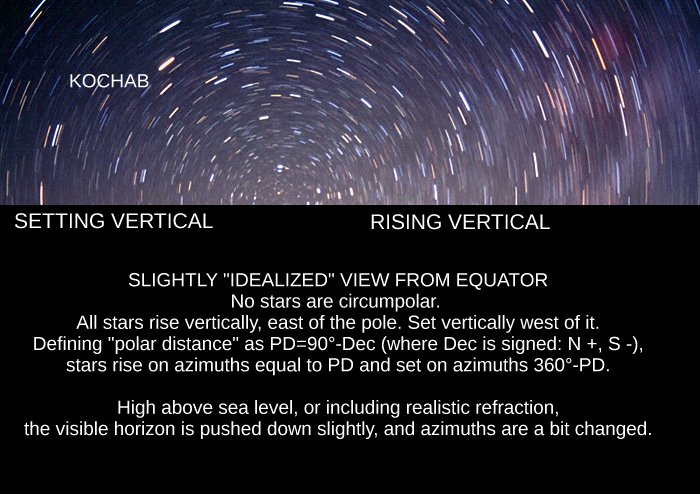
Yes. I mentioned in another comment that this can be summarized nicely if we use the concept of "polar distance". This was more common in historical navigation, but it still comes up in modern celestial: pd = 90° - Dec, and we remember (since we're in the 21st century) that Dec below the celestial equator is negative. Then the rising azimuth of stars for observers at the equator is exactly that:
Rising Azimuth = pd.
And similarly:
Setting Azimuth = 360° - pd.
These results assume some idealization. We're talking about the rising/setting azimuths of stars visible immediately at the true horizon with no refraction and zero height of eye. The easiest way to see how this idealization would be broken is to look close to the celestial pole from a less ideal location (less ideal than sea level).
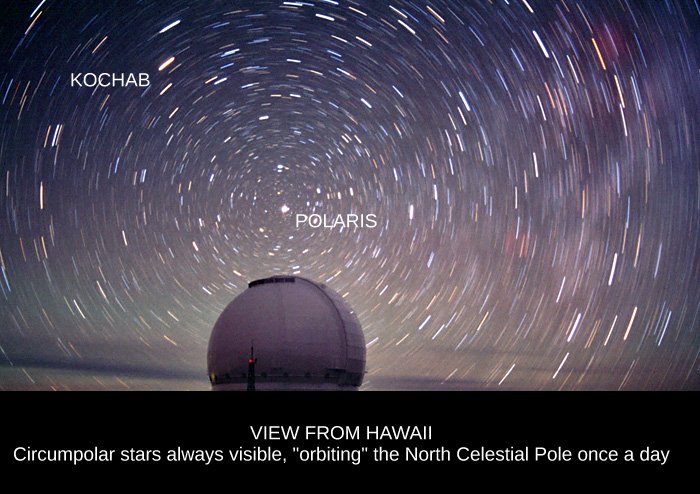
If we take a standard image of circumpolar star trails and cut it so that a horizon line neatly bisects the image at the pole, we are seeing the idealized view from the equator, and it's very close to what real observers would see, too. But we can ask how this would change in real world cases that are not idealized. For example, suppose we are flying above the equator at 40,000 feet. The dip in minutes of arc is then very nearly equal to the square root of the height so that gives 200' or, equivalently, 3° 20'. That's quite a lot and certainly visible from that altitude by looking at the north and south visible horizons on a dark night. Even from exactly along the equator, Polaris would be significantly, observably above the horizon at all times when flying at 40,000 feet. We would get another 5-10 minutes of arc increase in altitude from refraction. Given the small p.d. of Polaris (around 40'), the observable altitude of Polaris above the so-called "visible horizon" (though not literally visible at that altitude would range from a bit more than 4° to about 3°, and it would never set! Other stars would have modest "arcs" of their circumpolar paths visible so the rising and setting locations would shift slightly. This is where the "approximation" mentioned by Martin in his earlier post would come into play.
Frank Reed