NavList:
A Community Devoted to the Preservation and Practice of Celestial Navigation and Other Methods of Traditional Wayfinding


From: Kevin Stalder
Date: 2026 Jan 27, 10:32 -0800
My interest in cel nav originated during my younger days flying mostly deHavilland Twin Otters in the northern latitudes of Alaska and Canada. This time period for me was from the early seventies through the mid eighties. To share my cel-nav experience here (limited to the Mk II astro-compass), I feel that I'll need to briefly set this up.
Of course, there was no GPS then and few ground-based Nav-Aids. There were non-directional beacons, (NDBs) at the Distance Early Warning (DEW-Line) sites along the western and northern Alaska coasts, and eastward into Canada. These sites obviously also had radar. Sometimes the military controllers would assist us with a "steer", and sometimes they would refuse. I suppose they had directives regarding navigationally-challenged civilian aircraft.
If we were flying to sites offshore out on the ice-pack, we were required to file a "Defense"(DVFR) flight plan, so that we weren't mistaken for bad actors when we appeared on radar. Offshore flying onto the permanent ice-pack was usually for the US Navy in support of submarine exercises, or for University-funded scientific experiments.
Supporting oil exploration was a large part of our work back then, and that occurred as well in these higher latitudes. As an example, Resolute Bay, Nunavut, Canada at 75N, was a hub for oil and mineral exploration.
At these latitudes and locations, obviously the standard compass in the airplanes had limited or no usefulness. In addition to the standard "whiskey" compass, the airplanes were equipped with .at least one gyro-compass receiving heading information from a remote-mounted "flux-gate", located far out in the wing structure, away from electrical interferences. In the cockpit, we could connect (slave) our heading gyro to this flux gate, or disconnect (free) the gyro from the flux-gate and simply tell the gyro what our current heading was. The information supplied by the flux-gate was also erroneous and not to be trusted for the same reasons as any standard compass, and therefore we always operated in the "free" mode. On the co-pilot's side in the cockpit was a simple gyro heading indicator, either vacuum or electrically-operated. This indicator had to be manually set always and had no flux-gate input.
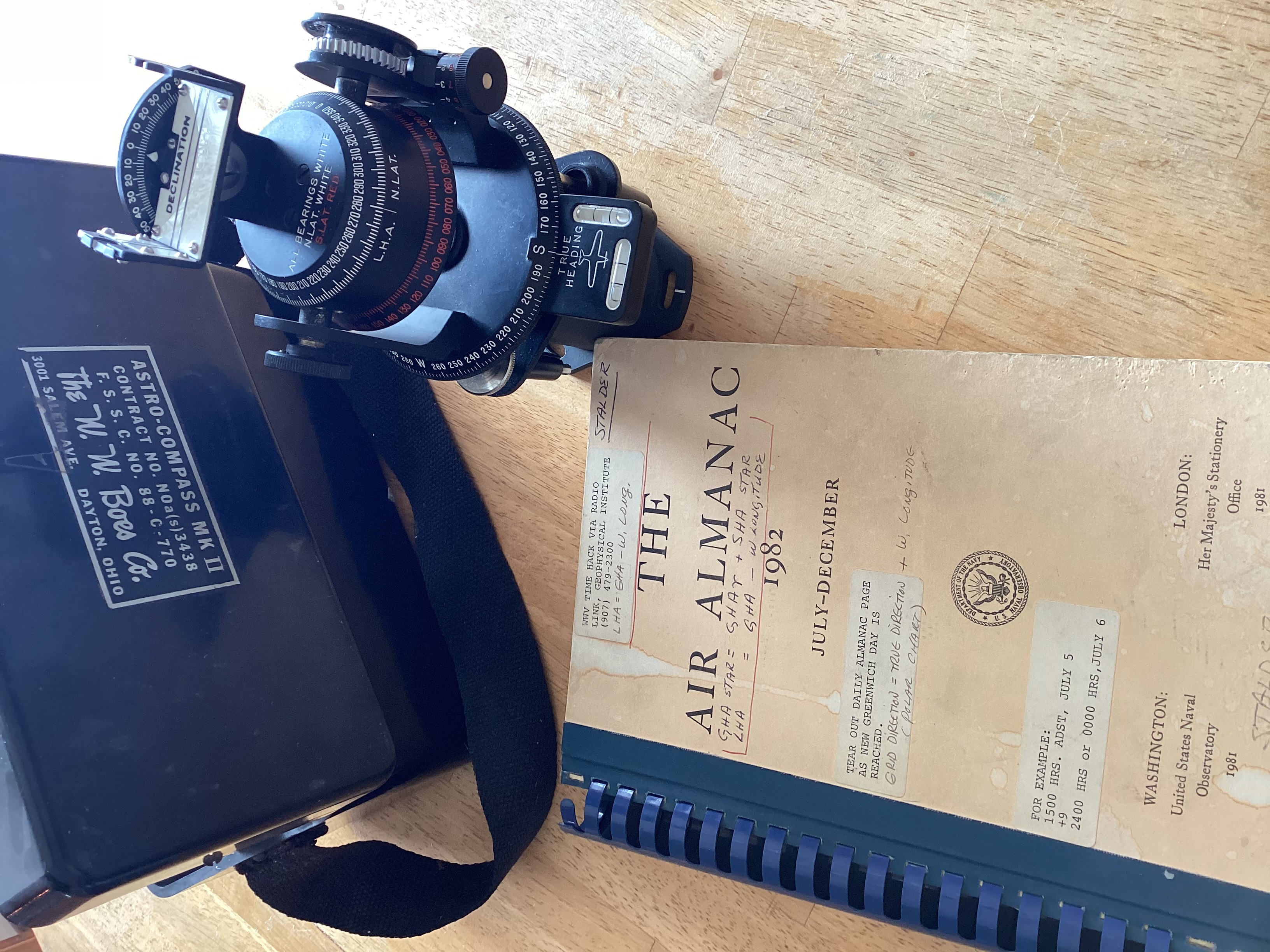
The heading to set into the cockpit gyros to was derived by using the Astro Compass. There is no astrodome in a Twin Otter, so the Astro Compass was usually used out one of the side windows or the windshield. These Astro Compasses had a specific mount, and I still have one, but there was really nowhere good in the cockpit to affix it. We did rig up a couple ersatz mounts, but I was never really thrilled with them.
In the spring and through summer, we used the sun and moon for sights. Since the sun never sets in summer, we used it until it got too high during the day.
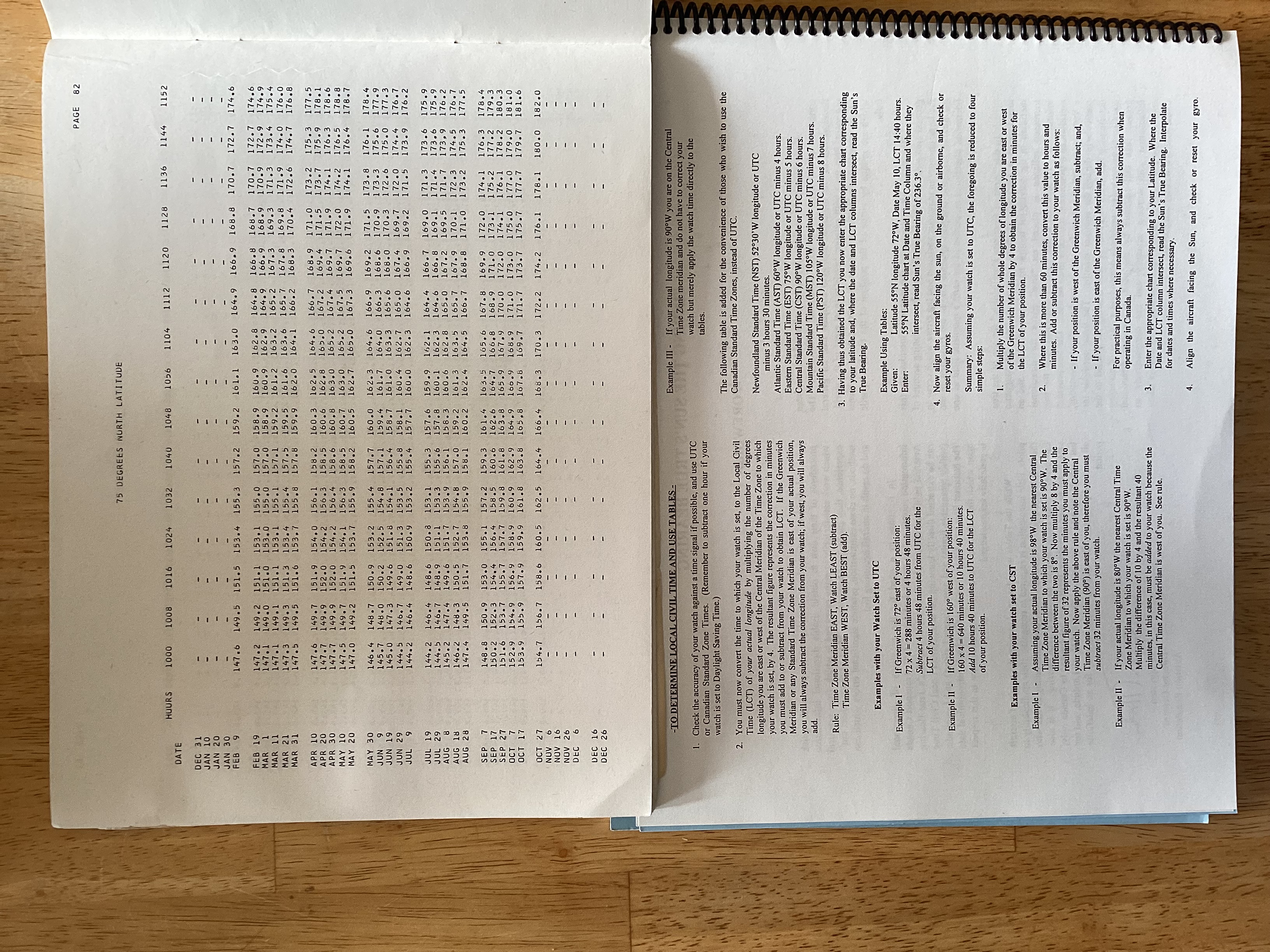
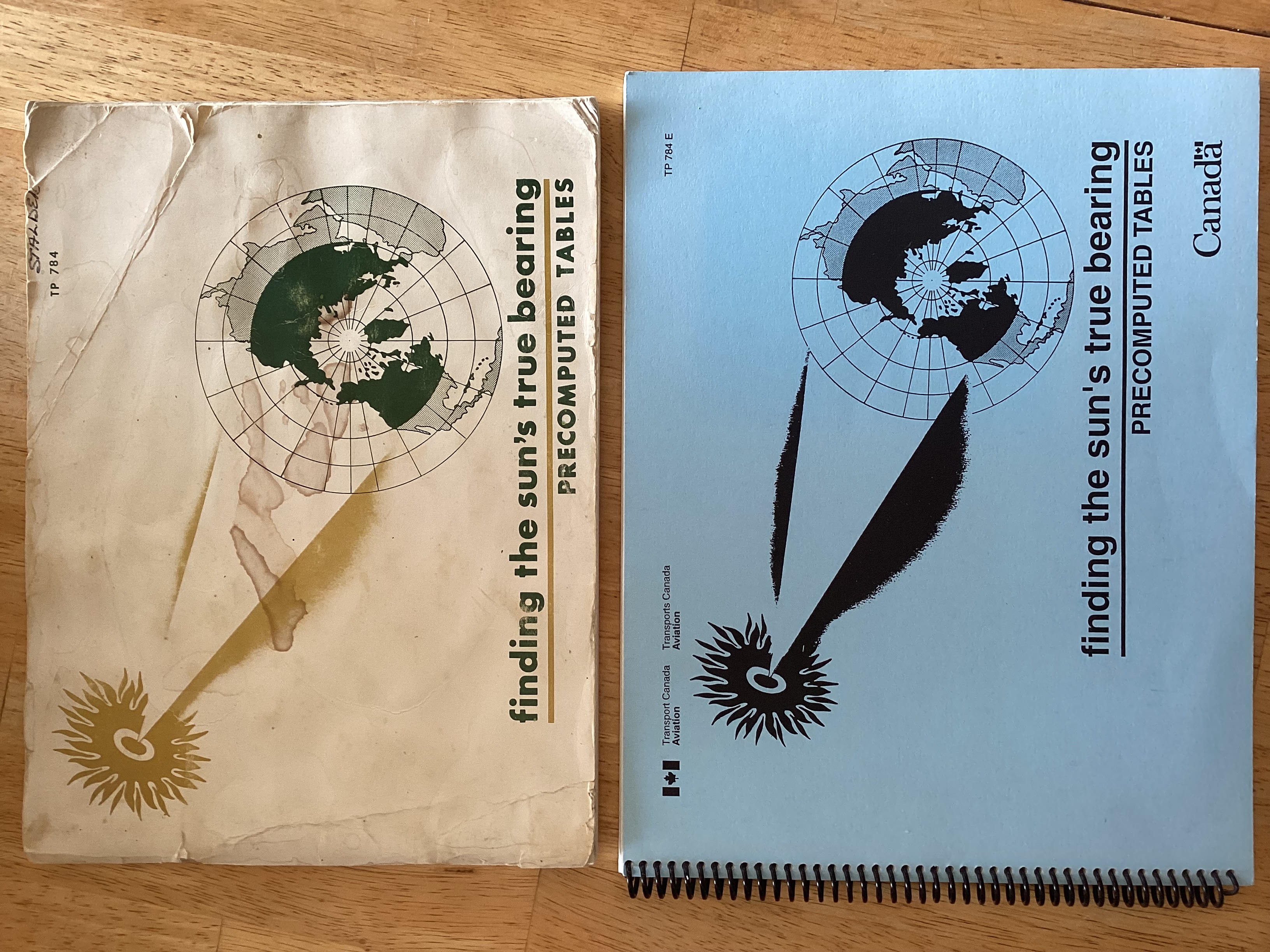
I want to say here that the Canadians have published for many years, precomputed tables entitled " Finding the sun's true bearing". This, we used a lot. With the DR Lon, figure your location's UCT, enter the table at your DR Lat to your date and UCT and read the sun's true bearing. This publication, Pub TP 784E, is still available; I recently ordered a new one as my old one was getting kinda shop-worn. I'll link to Transport Canada's site should anyone wish to order one. I've often thought that it would have a marine application, if only for emergencies.
The sun would disappear in November and reappear in February, so it was stars and Jupiter mostly, as I remember. The gyros would precess, and we would try to reset them every 15 minutes or so. We also kept a log of their precession rate so that we could adjust them if we couldn't see any bodies at the 15 minute interval due to weather. The cold weather was very hard on these gyros. The airplanes lived outdoors and heating them; getting them ready for flight, was a process. Of course we heated the cockpit and the gyros, but it is never very warm in a Twin Otter at -40 OAT, and in flight the cockpit would become cold, they would suffer, and would inevitably require replacement.
As I recall, we could usually get on top of the overcast which was almost always fairly low. Then it was DR to a destination, try to see lights if it was dark, or try to see something dark on the snow if it was light, of course after finding a break in the clouds. If there was an NDB, we'd perform an instrument approach and land. At some of the more remote sites, the landing strip, either on a frozen lake or the offshore ice, was lit by flare pots. Upon our radio request, someone would go out and make sure they were lit (hopefully).
That was our use of the Astro Compass; to keep our gyros set and then DR until receiving a usable radio signal or visually acquiring a site and then maneuvering to land. I can't remember if I ever used it as a pelorus; there was usually not much to see, landmark-wise.
I didn't intend to make this so lengthy, but as I began, it seemed as though some sort of operational description was required.
Later, I flew whale surveys over the Beaufort Sea with a VLF/Omega setup and the last time (spring 2007) that I flew in those latitudes, I supported the US Navy at a camp on the ice 200 nm north of Prudhoe Bay, Alaska; 70N, equipped with a GPS. Much better avionics than in earlier years, but in the spring and summer, I still always carried at a minimum, the Canadian Pub TP 784E, nonetheless. In the autumn or winter, I always carried my Astro Compass.
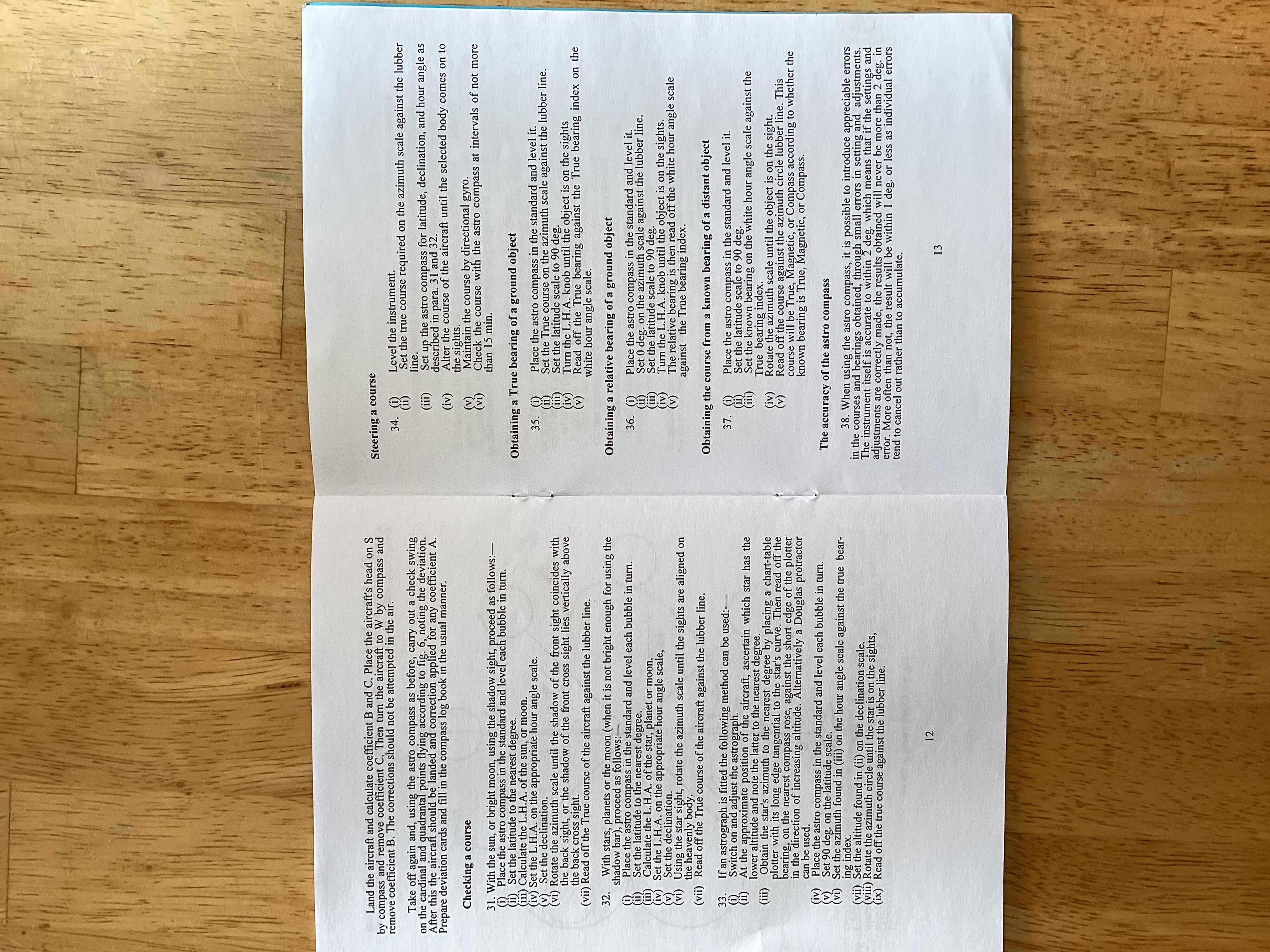
I was going to explain the setup of the Astro Compass but I saw a couple of good explanations on the internet. Here's links:
https://faaflightnavigator.wordpress.com/2014/09/23/how-to-use-the-astro-compass/
https://faaflightnavigator.wordpress.com/2014/09/25/how-to-use-the-astro-compass-at-night
A link to Transport Canada:
www.tc.gc.ca 1-888-830-4911