NavList:
A Community Devoted to the Preservation and Practice of Celestial Navigation and Other Methods of Traditional Wayfinding



From: Howard G
Date: 2025 Aug 11, 00:20 +0000
Hi Folks
Fell across this story and found loose bit of wool hanging out and tugged it with some research and actual air experience and things as written in story book didn’t quite ring true.
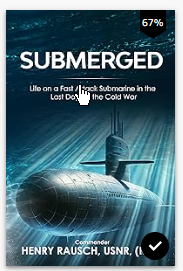
An extract from the book I am reading.
They have just been tasked to transit the North pole to the Greenland sea.
This is a non-fiction book – an actual submarine and an officer’s is writing this.
However, it is fairly dumbed down I suspect to keep its contents clear of even a smiggen of classified content – however, sometimes this dumbing down is a bit too much.
Whilst this chapter is about Navigation the other area that was also dumbed down a bit too much is the nuclear power plant – and if you read Colin Tucker’s ‘How to Drive a Nuclear Reactor’ before reading this book ( which I did) – you will
see what I mean.
However, I will agree that to keep a book interesting the author needs to keep technical stuff to a minimum – however, not at the expense of the story line
Read this chapter then read the link I have attached
Chapter 32: Sins with SINS
[SINS = Ships Inertial Navigation System]
While I was at Engineer school, what had been rumor became fact: Our ship was heading north, under the ice, to the North Pole. We were scheduled to leave at the end of August. Men had sought the North Pole for centuries, but it wasn’t until
the 20th century that man had ever set foot there. Peary had claimed it in 1909, but historians believe he came short by several miles and it wasn’t until 1947 that an unknown Russian airman set foot at the Pole, and not until 1968 did anyone get there by
traveling overland. The Pole and the frozen ice around it were a hotbed of activity. Canada claimed huge swathes of the area as internal territory, a moot point until global warming allowed ships to sail the Northwest Passage. Besides the oil and mineral riches
that lay beneath the icecap, the pole held attractions for submarines due to the difficulty of waging war there. Soviet missile submarines were believed to lie “icepicked” under the ice, waiting for the order to fire their missiles. It was almost impossible
to find an icepicked submarine. What little sound emanated was masked by a cacophony of crashing ice ridges and the ceaseless movement of ice flows. Even if a submarine was detected, shooting it with a torpedo was nigh impossible. The active sonar homing used
by torpedoes reflected off ice ridges in a hundred different directions. It was like shooting a laser in a funhouse hall of mirrors. Into this frozen and forbidding underworld we sailed on a mission classified to this day. Preparations were already underway
when I got back from DC. Navigating under the ice presents challenges and requires skills and equipment not normally experienced in everyday submarining. For starters, the ability to surface under the ice was limited to boats of our class. The newer submarine
class, in a cost-cutting move, had not been built to do so. They have improved over time, but the initial models of the new class were built to do one thing well: Go fast and keep up with a carrier battle group. Everything not contributing to that mission
had been cut out. They had only three watertight compartments, not five. The screw was directly attached to the reduction gear, not via a clutch, to accommodate the increased torque of a larger power plant. This meant that if the reactor failed and the ship
had to be driven on the electric propulsion motor, that motor was driving the entire drive train, including turbines, a much higher draw on the battery than merely turning the screw. Our class of subs had been built from the very top of the sail to operate
under the ice. The sail was hardened so it could be used as a battering ram to smash through the ice when surfacing. The masts and antennas could be retracted deeper into the hull, in an “under ice position,” to prevent damage. Our fairwater planes could be
rotated ninety degrees straight up, to present a clean knife-like surface to the ice as it cleaved through it. Our boat had two blow systems to surface. The Emergency Blow System dumped the contents of four high-pressure air banks into the ballast tanks through
a five-inch diameter pipe. This launched the boat out of the water like a surfacing humpback whale. The boat gained tremendous momentum as it went shallower. The entire bow would clear water at a sharp angle, only to crash back in a resounding splash. This
was great for flooding and never failed to impress visitors, but not so great for emerging carefully under the ice. Surfacing through the ice this way would smash the front of the ship. The newer class only had an emergency blow system, they had no way to
surface under the ice. We also had a Normal Blow System, allowing us to send air into the ballast tanks at a more gradual rate. We had been fitted with a vernier control. With this, we could hover at a pre-assigned depth, and then dial in a desired ascent
rate. After we had found a surfaceable feature, we would come to a stop, dial in a moderate ascent rate, and ascend slowly, straight up until the sail made contact with the ice, gently. Once we were “icepicked,” with the sail pushing at, but not through the
ice, we would “goose” the forward ballast tanks a bit, putting more and more air into them, until the increasing buoyancy, all focused on the front end of the sail, would overcome the ice and the sail would crash through, rising through it. Our wardroom sat
in the front row of the base auditorium. Behind us, the Quartermasters and Navigation Electronics Techs from the boat. A Lieutenant in dress khakis stood on the stage. He was from the Navy Arctic Lab in San Diego, and he was there that day to teach us the
basics of navigation under the ice. “Every inertial navigation system needs a reference point. The newer systems are oriented to a fixed point in space, so navigating to the pole presents no extra difficulties.” He paused. We waited for the other shoe to drop.
“Yours, however, is one of the older models. It is oriented to the earth. To the North Pole, in fact. Which does present difficulties.” He pointed at the screen; it showed a model of how our inertial navigation system worked. A platform was stabilized in three
axes by a set of gyros, which spun very fast. By the principle of conservation of angular momentum, they resisted displacement. These “resistance movements” were fed into a feedback loop with a series of motors, which kept the platform motionless with respect
to Earth. We had all seen this in action. The SINS (Ships Inertial Navigation System) binnacle was about the size and shape of a ball turret gun placement on a B17 bomber. It was mounted in the Operations Compartment directly above the ladder between OPS Upper
and Middle level. If you were tall and careless, you banged your head on it on the way down. Watching the binnacle move while the ship maneuvered was an exercise in shifting reference frames. If we took a down angle, the huge sphere tilted up, if we tilted
to the right, the binnacle turned left. But its motion was an illusion. Relative to the earth, the gyros and motors kept the binnacle stock still. It was our ship that moved around this motionless sphere. The binnacle hosted a set of accelerometers that measured
speed and displacement in the three axes. The SINS was a very accurate dead reckoning device: It started from a known point and measured how long and at what speed and direction we traveled, so it had a good idea of our position. A good idea, but not a perfect
one. Errors would accrue over time. In practice, we needed to inject a current position into it at least every day to correct for them. That was the science of it. In practice, operation of the SINS was a black art. The Electronics Techs would feed fixes into
it and peer into the numbers, applying abstruse corrections, and our position would be deduced, as if by magic. I talked with a fellow who had used the earlier SINS models and was impressed by how much they had improved. “The early versions, if you told it
where you were, it would tell us where we are.” Our SINS was much improved, but still, it was just one tool in a host of navigation inputs. We had the EM (electromagnetic) Log to measure speed and the gyrocompass for dead reckoning. We could always come to
PD for a Navsat fix. We were about to learn that operating under the ice, all that was about to change, and our lives would depend on this one powerful but rather finicky device. The LT from the Arctic Submarine Lab flicked through a series of slides. “As
you head north, the SINS platform becomes more tilted. If you sail over the North Pole, the binnacle will maintain its relative position to the Pole and try to flip itself over.” Murmurs of concern rose from our group. The LT paused for dramatic effect. “The
solution is, we move the North Pole.” He flicked to a slide that showed the “new’ North Pole, it had been slid down the International Date Line to the intersection of the 180 Meridian and the Equator. “When you are at the Pole, SINS will think you are on the
Equator, at the International Date Line.” A few “aahs” rose from the crowd. We all understood that coordinate systems are arbitrary. The XO had a question. “If SINS is using the new coordinate system, how do we convert those to the normal latitude and longitude?”
The LT had an answer. “SINS will do that for you. You can operate with standard latitude and longitude; SINS will operate in the new coordinate system and make the conversions.” Then the bombshell. “As you go farther north, SINS will be your only heading reference.
Beyond about 87 or 88 North, your gyrocompasses won’t work.” The wardroom erupted in confused voices, sputtering. Heresy! A hallmark of submarining is to have backup systems. We had two independent gyrocompasses onboard. The LT from the Navy Arctic Lab was
taking those backups away. Our Chief QM spoke up. “What do you mean, they won’t work? Do they stop spinning?’ “They spin just fine. But that far north, the earth doesn’t spin. At least not enough for the gyrocompass to work. The gyrocompass uses gravity and
the earth’s spin to orient itself to north.” The LT was enjoying himself. “But here’s the thing, that far north, even if the compass worked, it wouldn’t be much use. Headings get meaningless the farther north you go!” Confusion reigned. What was this nonsense?
He put his hands up to quiet us. “Consider that a heading is nothing more than an angle measured to a line of longitude.” The LT called up a new slide, showing an exaggerated globe with tiny compasses arranged along a meridian, like pearls on a string. “This
works fine when the lines of longitude are more or less parallel. But as you go north, the lines of longitude converge, to a single point at the Pole. Say you’re at 89 North and try to head east, a heading of 090. The minute you step off your line of longitude,
you are not heading east anymore, the angle you make to your current longitude is something south of east. If you keep at your original direction, you will be heading south. If you try to keep a ninety-degree angle to each line of longitude, you will spiral
northeast to the pole.” He drove the point home. “As you head farther and farther north, “east” becomes meaningless.” The LT concluded his class in polar navigation. “When you are under the ice, the SINs will be your only navigation aid and your only heading
reference. Take good care of it.” Some years after our ice run, another boat at the Pole would lose its inertial navigation system. Absent it, there was no way to tell which direction they were traveling. With no heading reference, they embarked on a last-ditch,
desperate sprint to the south, 180 miles at top speed. This was like closing your eyes and trying to walk a straight line for 180 miles. When they finally surfaced and were able to get a fix and their gyrocompasses started working again, they found their navigation
was “a little off.” The boat was at the latitude they expected but had missed the target longitude. By 145 miles. A direct quote from the Assistant Navigator of that boat: “I was happy enough just being on the right chart!” We all nodded our heads in agreement.
The SINS would be the only thing we would have to take us to the Pole, and, more importantly, bring us home. We damned well would take good care of it! This made it all the more tragic when, three weeks later, Daniel and I did our level best to destroy the
SINS through a combination of miscommunications and carelessness. # Daniel and I had the duty the weekend before we left for the Pole. He was forward (SDO-Ship’s Duty Officer), and I was aft (EDO-Engineering Duty Officer). The weekend before a long run, everyone
who doesn’t need to be on the boat is off. Married men were getting some last hours with their families, trying to cram months of missed birthdays, soccer games, and school recitals into a few frantic days. Single men were finding a place to store their cars
and tying up loose ends, such as paying rent and bills ahead of time. Daniel and I were going through last-minute pre-deployment actions. I was in Maneuvering, conducting a tour and looking at the reactor pre-critical checklist when I heard the familiar “whoop-whoop”
of the sound-powered phone. Daniel’s voice came through the handset. “EDO, de-energize the port DC bus.” That was not unexpected. I had gotten a pass-down that we would be doing some maintenance that required the port DC bus to be down and had been waiting
for it. I had the Duty Electrical Operator with me in Maneuvering for that very reason. The Navy adheres to a rigorous protocol when conducting maintenance to avoid killing someone. Breakers are opened to de-energize the equipment and large red tags are hung
on them, to alert everyone not to shut them. Ditto for valves that could release high-pressure steam or radioactive water or flood the ship. There was nothing so sacrosanct as the tagout system. I gave the order. The Electrical Operator reached up and switched
the port DC breakers to open, noted the correct indication on his panel, and made a notation in his log. I did the same in mine. About a minute later, the SP phone whooped again. It was Daniel. “Did you take down the port DC bus yet?” “Yeah, I was just getting
ready to call you--” “I think SINS was on the static inverter.” “Oh-my-fucking-Christ-holyshit-what-the-fuck-DANIEL?” “I know I know. What it was doing on it I don’t know. I didn’t check it.” The SINS ran on 400-cycle power. Like all critical systems, it had
redundant power supplies. Normally, it was powered by a 400-cycle motor generator set. An electric motor on the starboard DC bus ran a generator that produced 400-cycle AC. In an emergency, a bus transfer switch moved the power source to the static inverter,
which took electricity from the port DC bus and turned it into 400 hz AC. By de-energizing the port bus while SINs was on the static inverter, we had suddenly chopped its power source. The SINS had gyros which spun at several thousand rpm. It took an hour
to shut them down. The gyros were gently slowed and stowed in a caged or locked position. But we had chopped power to it, roughly the equivalent of stopping a car by driving it into a brick wall at twenty MPH. I was standing under a cold draft from the air
blower in the overhead, but felt my face flush and sweat trickle down my sides. I was scared. “You call the skipper and the Nav. I’ll call the Eng. We are so fucked.” In an hour, most of the Electronics Techs and every senior officer were on the boat. The
Eng was with the captain in the skipper’s stateroom, the Nav was fussing at the SINS station with the NAV ETs. I was hiding back in the engineering spaces. When something bad happens, it is best not to be in the line of fire. There were a lot of angry vibes
in OPS at that moment, and I did not intend to be, as we referred to it, the “shit sponge.” On paper, I was blameless. As the Ship’s Duty Officer, it had been Daniel’s responsibility to make sure SINS was on the other bus before he ordered me to drop the
port bus. But I knew, and everybody knew, that defense was utter horseshit. The skipper and Nav had trusted both of us to make the ship ready to sail, and we had failed them. I felt like crap. About an hour later, the Nav made a surprise visit to engineering.
He was not angry. He was sad. He had the demeanor of someone whose faith in humanity had been shattered. Like his best friend had run off with his wife, in his truck, and run over his dog when he did it. He looked at me with pleading eyes. “Did you make any
attempt to run a checklist, to look at everything on the port bus, before you dropped it?” “No Nav. I didn’t. I should have. I’m sorry.” He nodded morosely and went forward. Much later that night, everybody had gone home except the duty section. The NAV ETs
brought up SINS and were nursing it back to health. I ran into the duty ET in the crew’s mess when I went forward to grab some coffee. “How is it?” I asked. “Coming back up. Still a ways from where it needs to be.” “How far off?” “It thinks it’s in Cleveland
right now.” By the next morning, SINS appeared fine. It was reporting our correct position tied up to Pier Mike. But SINS was finicky even in the best of times. It would remember this insult and take its vengeance when it could hurt us the most. Either by
nature or affectation, Daniel was the most phlegmatic person I had ever met. Nothing rattled him. He took things in stride and never showed any emotion. He didn’t show any now. We were sitting in the wardroom after the duty day, having just finished breakfast.
He looked at me with those sad eyes across the wardroom table. “You know, if anything happens to the SINS on this run, it will be our fault. If Cthulhu reaches out and rips the binnacle out of the hull, it will still be our fault.” “Yeah, I know.” A pervading
sadness held me in a bear hug and would not let me go. Chapter
Rausch, Henry. Submerged: Life on a Fast Attack Submarine in the Last Days of the Cold War (pp. 226-236). Kindle Edition.
A very interesting read and all that is written is my understanding of polar navigation.
https://www.usni.org/magazines/proceedings/1958/december/navigating-under-north-pole-icecap
My experience to explain – I have 4000 hrs of RNZAF navigation – 3000 in a P3B Orion long range reconnaissance aircraft – we have operated close to the Arctic and Antarctic regions
on patrol but never close enough our Litton ASN42 needed to go polar.
However, at navigation school we learnt Grid navigation – extensively used when navigating in the polar regions – and we did training flights where we had to draw our own Grid
map and then navigate at night using this with our gyro compass set to free gyro and out of gyro-compass..
For those not familiar with Grid Navigation here is a reasonably good overview of its workings
https://skybrary.aero/articles/grid-navigation
Whilst I suspect the story line was kept flowing by the author – I think ( a personal view) it was a bit dumbed down.
Please feel free to comment at will – am I too sensitive about the lost art of navigation or was the author keeping the story going at the expense of the detail.
Regards Howard G
PS if you have no experience at inertial navigation and the physics of it – that is actually another very interesting area of reading.
https://en.wikipedia.org/wiki/Inertial_navigation_system
Dr Howard George (B.V.Sc (Massey NZ))
PO Box 390
Bowral
NSW 2576
Australia
M: 0415262694
The Raptor Business Services
[Book keeping using MYOB since 1994]
[ MYOB Certified Consultant since 1998]
[MYOB integration specialist using APIs]
[Database design/integration MSAccess]
[C# Visual Studio apps]