NavList:
A Community Devoted to the Preservation and Practice of Celestial Navigation and Other Methods of Traditional Wayfinding

Re Obtain a fix when you don't have an clear AP.
From: John Brown
Date: 2015 Jan 18, 14:01 +1030
v\:* {
BEHAVIOR: url (#default#vml)
}


From: John Brown
Date: 2015 Jan 18, 14:01 +1030
|
John,
I am strictly a backyard navigator interested in taking sun sights with simple equipment so when posting something on a sight that is viewed mainly by professionals I thought I should be spot on with my terminology. Therefore I consulted the list of abbreviations in the back of your excellent book and found the following:
AP assumed position ( a geographical reference point).
As my geographical reference point was to be the whole of the United States I thought the abbreviation and use of the term more than appropriate. However in your posting you have changed the meaning of AP to mean " assigned point " and say that the use of the term " assumed position " is bad and misleading.
I cannot imagine what you find wrong with the procedure used. It used LOPs from two sights - not just one as you seem to assume - and I have been led to believe that a position is obtained when two LOPs cross.
Most importantly of course, it gave the right answer.
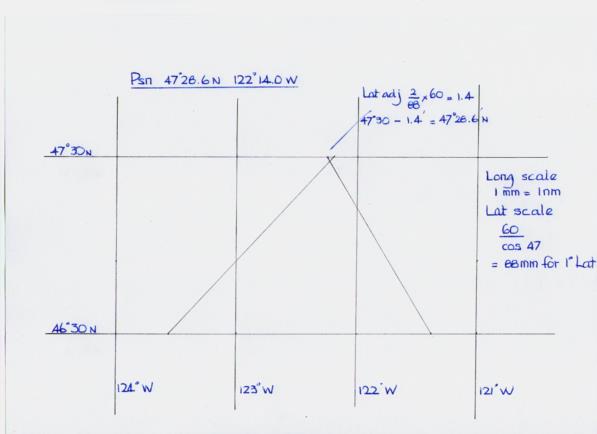
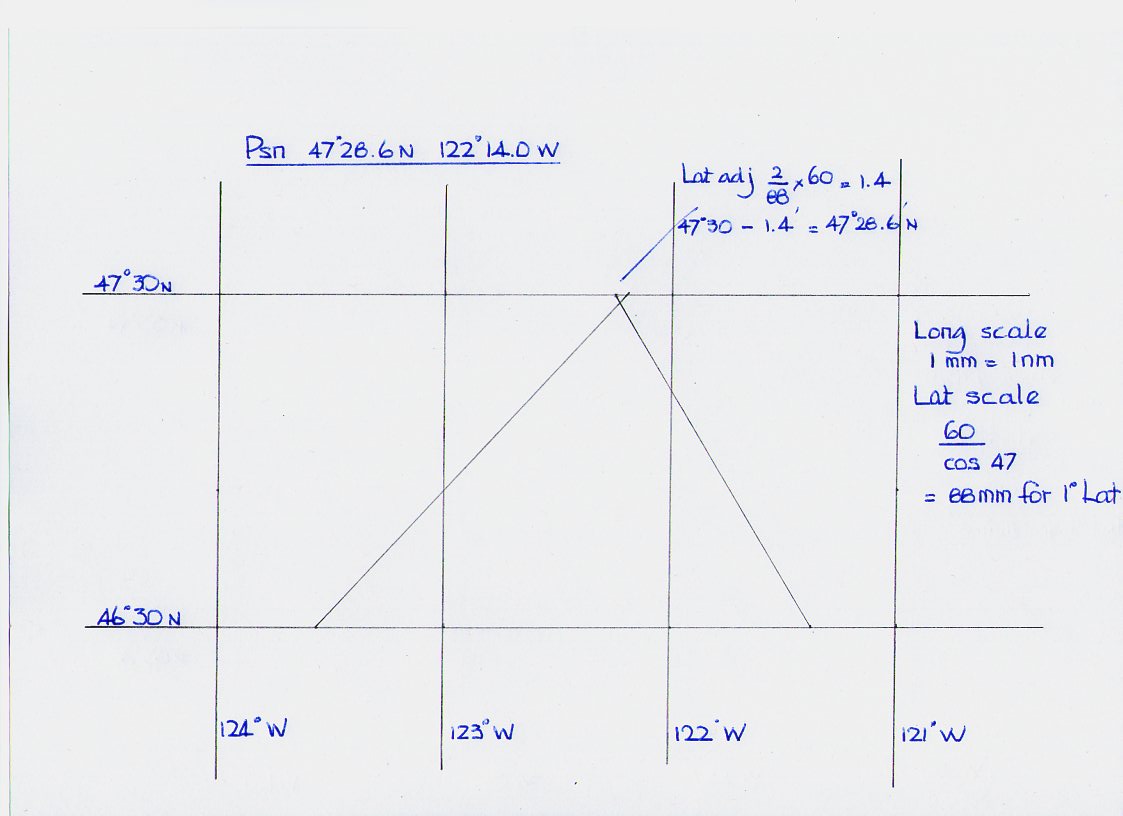
When I was first learning to do the calculations for position finding I would occasionally go into the countryside with a handheld GPS and take AM and PM sun sights with sextant and AH. I had absolutely no idea of my longitude ( I wasn't keeping a running log ) but I knew pretty well what latitudes that I was in between and used the Sumner method for calculations and Ure's method to find a position without the difficulty of having to draw LOPs on an ordnance survey map. The GPS was consulted only after the calculations were done. This is essentially the method used in the current exercise only the area of uncertainty is so much greater.
Incidentally in Ure's non mathematical method he uses the term Polar Angle rather than LHA.
I have the 2007 edition of your book so you may have changed the definitions since then. They say to learn anything you should always read books that you don't understand. That is how it is with your book. There's a lot in there I still don't understand but I've also learned an awful lot from it.
Regards,
(the other)
John Brown
Adelaide, South Australia.
| |||
|
|
File:



File: