NavList:
A Community Devoted to the Preservation and Practice of Celestial Navigation and Other Methods of Traditional Wayfinding



From: Frank Reed
Date: 2025 Sep 30, 11:41 -0700
David Pike, you wrote:
"Miss Binnie Hale would know."
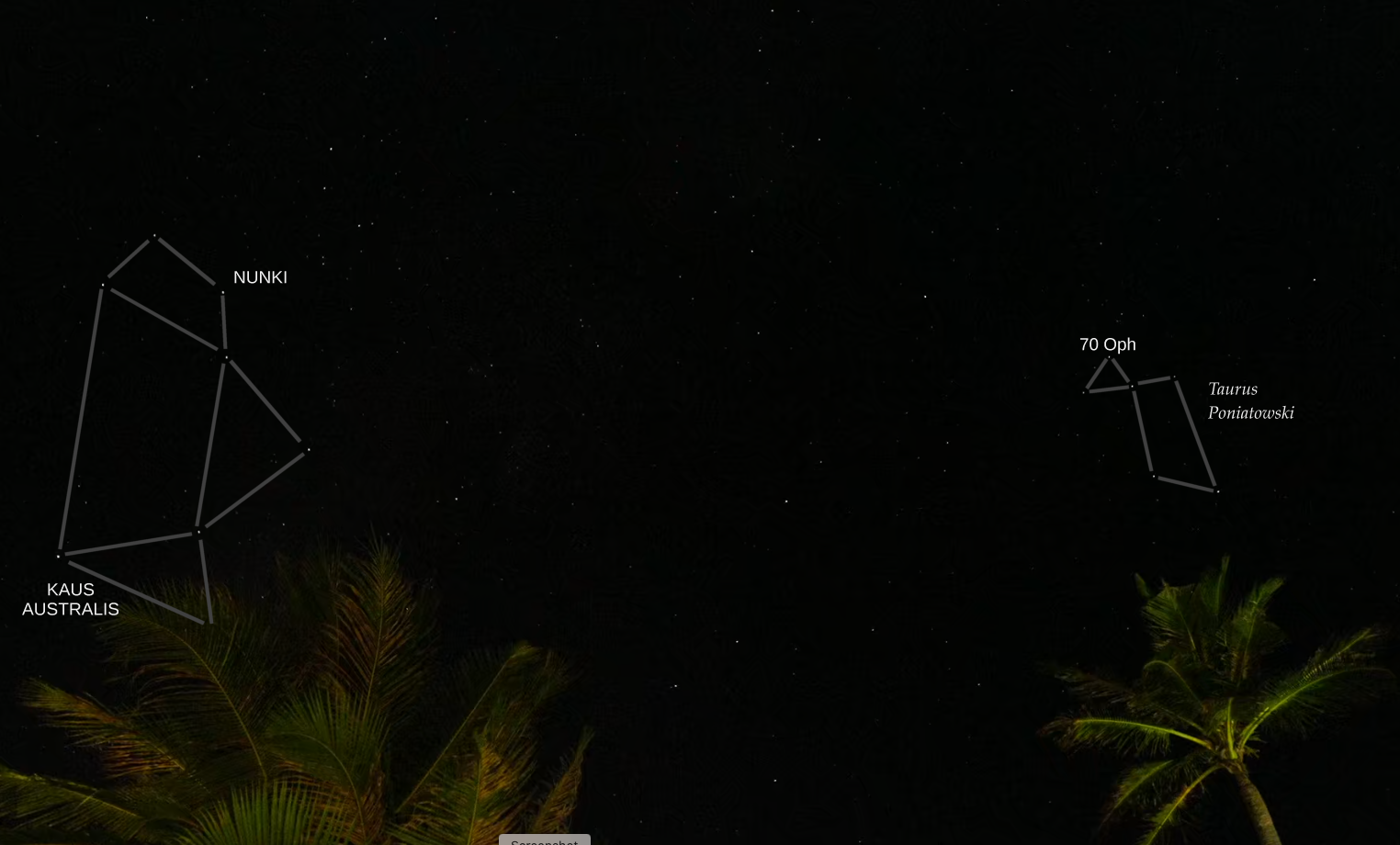
That's a great reference to GMTeaTime. And, yes, my clue was meant to call out the "teapot" of Sagittarius. :) I think both you and Dave Walden had figured this one out. I left it for a while to see if anyone else would give it a go... but no :). I'm attaching a "marked up" version of the stars in that image below. Incidentally, the photo was taken from a small, remote island in the Maldives. The view was somewhat spoiled by light pollution, which is rather sad when we consider how brilliant the sky should be from that archipelago. This part of the sky, running from Sagittarius up through Scutum and into Aquila famously includes some of the best star clouds of the Milky Way. But they're gone.
The two "official" navigation stars in the image are Nunki and Kaus Australis, both in the teapot. And, I would add, one or both are interesting examples of mediocre choices for navigation stars... we don't need two so close together, and there's little use for stars as faint as these two.
I also mentioned my favorite obsolete constellation, Taurus Poniatowski, and my favorite nearby star, 70 Ophiuchi. That star is just about the same distance as Altair, both about 16.7 light-years away [and 70 Oph is the original home of the aliens/gods who run this part of the Milky Way (that's what they tell me, at least... but they could just be making it up)]. There was also once a planet orbiting in the 70 Oph system, discovered in the late 19th century. It didn't exist, but that failed discovery has since become an opportunity to "damn" one rather marginal astronomer from that era: T.J. See.
That little grouping of stars, once identified as Taurus Poniatowski, has a few other claims to fame. That group was noted even by Ptolemy in the Almagest star list --noted for the curious fact that it was a group of "unformed stars" meaning stars that were not specifically assigned to fill out the figures of the Ptolemaic constellations. They were Ptolemaic "orphans"... This group also, rather strangely, turns up often in film/tv. It's in an episode of "Star Trek" that first aired in 1989 though those stars probably are a result of the digital remaster project around the year 2012. I speculate that the frequency of their appearance is related to the fact that they are close to a simple pair of coordinates (18h RA, 0° Dec).
And this group of stars does have some modest value for navigation. It's always handy to know where the celestial equator (0° Dec) is located when looking at the sky: there's Mintaka on Orion's Belt, the water jar in Aquarius, and also this small grouping in Ophiuchus. They're all on or very close to 0° Declination, implying that they rise and set exactly due East and West everywhere on the globe and implying that their maximum daily altitude (when hitting the meridian) is just the complement of the Latitude (90°-Lat).
Frank Reed