NavList:
A Community Devoted to the Preservation and Practice of Celestial Navigation and Other Methods of Traditional Wayfinding



From: Murray Buckman
Date: 2025 May 16, 11:27 -0700
In making a choice I would ignore the difference in the images (vernier and no vernier) and focus on the rest of each sextant, glass, mirrors, scopes, overall condition etc.
Having used both styles at sea on small boats (and in concert with others' comments) I find no practical advantage or disadvantage in the vernier scale. That said, I have not experienced the risk others have mentioned, of the potential to misread the scale (at least as far as I know or remember, as there is always the possibility of a misreading that I never detected or eliminated when selecting from a set of sights). When used 3 or 4 times a day in a race in good weather and a couple of times a day in good weather on a mid-ocean passage, familiarity with the tool was not a problem.
I do agree that the legibility of the markings to be read is important, especially in low light.
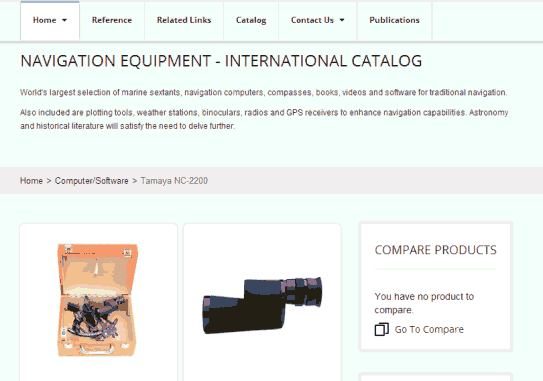
An observation: two of my sextants were acquired from deck officers in the merchant marine, and so their first life was on board ships rather than small boats. One has a vernier and the other does not. My cleanest sextant is a Tamaya that looked like it had never seen salt in its first life on aboard ship. That model has no vernier. Looking back at the marketing material from the time (1970s) before commercial shipping had either Transit or GPS, some material was marketed at professional users and some at the recreational market (some was aimed at both). For Tamaya, I see images in marketing material perhaps slanted towards the professional user without the vernier scale. I see recreational market material with the vernier scale. The underlying sextant was essentially the same but was marketed with a number in professional catalogues and with a name in the recreational advertising. Later, as sextants ceased to be the primary method of fixing a position at sea and the market diminished, the available variations reduced and the marketing material addressed both sets of users. This was not universal. The model I own evolved to became the MS-733 which (I think) always had a vernier. Others may know better than me.
Marketing material for the recreational yachtsman may have highlighted the perception of accuracy from the supplementary vernier as a marketing tool.
From the practical perspective, and again speaking as a small boat navigator, I am more interested in where I am not, rather than where I am. I want to know that I am not standing into danger. Sailing my preferred course is secondary to that. Pre-gps, I would plan a landfall based on confirming a land-based object (hill, light etc) as soon as possible and from a safe direction. Similarly I would plan to avoid a hazard at sea by miles, not yards or meters. This was true even when racing, though with narrower margins. So given all of the available information, which could be a lot, or not much at all depending on the circumstances, I have in mind the posible error in my position and the directions that error could be toward. This is measured in miles, not yards or 1/10th of a minute. If the available data is poor, this could be many miles. Believing that I can read a vernier scale off a micrometer sextant and somehow get a useful increase in accuracy is a risk, rather than a benefit. Just my opinion.
Also, looking back at old logs and sight reduction workings done with pencil and paper at sea, I often worked sights to the round minute, or would "tweak" an adjustment to get to a round minute. My thinking was always that I should reduce my risk of arithmetic (or calculator keying) error and calculation steps rather than focus on a theoretical accuracy of less that a mile when the nearest land or hazard was well below the horizon. I would always assume a maximum likely error towards a hazard.
I'm off to make a loaf of bread. I need precisely 350 grams of water. 351 or 349 simply will not do.