NavList:
A Community Devoted to the Preservation and Practice of Celestial Navigation and Other Methods of Traditional Wayfinding



From: Luc Desmedt
Date: 2026 Apr 17, 14:00 -0700
Pocket Calculators and Navigation: What Specification Sheets Do Not Tell You
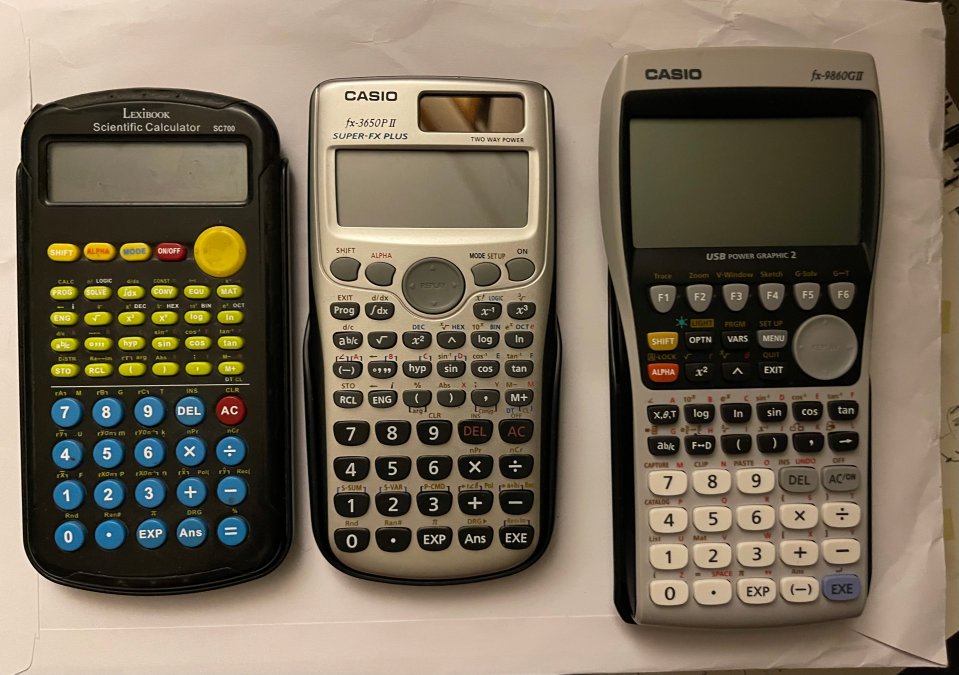
About ten years ago, I bought a small Lexibook SC700. It already contained two programs that were useful to me: computed altitude (Hc) and azimuth.
With that modest machine and its little programming booklet, I gradually learned to use cos, cos⁻¹, then haversines, A, B & C tables, and rhumb-line sailing through SOH CAH TOA. An entire world opened.
Having left school at fourteen, I had not followed the traditional path into mathematics. Yet through that calculator, I was able to begin reading certain equations, then bring them to life on the keyboard, almost as a musician interprets a score.
Years passed, the keys aged, and it became time to look for a replacement.
My requirements were simple:
- AA batteries, easy to replace
- backlight
- programmable functions
I then found a used Casio fx-9860GII at a very reasonable price. A fine machine: solid, serious, and clearly well built.
But I soon discovered a different world.
This more powerful calculator was also far more demanding. One misplaced parenthesis, and the calculation was rejected. Useful functions such as degrees-minutes-seconds were hidden in menus. My old programs could no longer be entered in the same way.
After many hours of trial and error, research, and several litres of coffee, I eventually succeeded in entering my Hc and azimuth programs. I do not regret buying it. Its strictness forced me to improve.
Later, I bought a more modest machine: the Casio fx-3650P II.
There I discovered what I would call an intermediate category: more advanced than the Lexibook, simpler than the graphing model. It already offered useful structures such as If, IfEnd, tests, and logic, while still feeling close to a practical field calculator.
Today, I understand the difference between a basic programmable calculator and a graphing machine.
But what strikes me most is the difference between two calculators that might both appear, on paper, to belong to the same modest category: the Lexibook and the Casio fx-3650P II.
On specification sheets, they seem similar. In the hand, they belong to different worlds.
That may be the real lesson: published features do not tell the whole story. Ease of use, tolerance for human error, real ergonomics, and input logic may matter more than memory size or the number of functions.
And for a navigator, that can make all the difference.
I would be very interested to hear the views of NavList members: beyond the commercial specifications, what criteria would you consider essential today in a truly practical calculator for navigation?