NavList:
A Community Devoted to the Preservation and Practice of Celestial Navigation and Other Methods of Traditional Wayfinding


From: Alexandre Eremenko
Date: 2025 Dec 9, 06:31 -0800
Dear Modris,
Your memories about that Soviet table coincide with my own, and I am sure that I can find it among my papers, if there is a need.
You wrote: Today (Thank God) we can calculate...
I am not sure whether I have to thank God for this or not:-) My feeling about the superfast technical progress which happened during my life time are mixed. As a 14 years old I wanted to be a seaman, namely a navigator (there was such speciality, and I wanted to quit high school early to enroll for the corresponding education institution.) My parents talked me out of it, and we made a compromise that I finish my high school first. When I graduated from high school, I already saw the first hand-held calculators, and understood that the profession of my choice will soon be eleiminated:-( And it was eliminated!) So these two inventions (calculators and navigation satellites) radically changed my life. Starting as a navigator, I could probably eventually become a merchant marine captain, instead of a math professor. I am not sure whether this was good or bad.
I owned only two sextants for many years: in addition to SNO-T, I have a pocket Troughton and Sims, with which I also experimanted. The scale reads to only to 1' accuracy but covers -5 to 150 d. It has a vernier with magnifying glass. I tried all possible observations with it, and they were always exact when rounded to 1'. So there is no detectable error whatsoever.
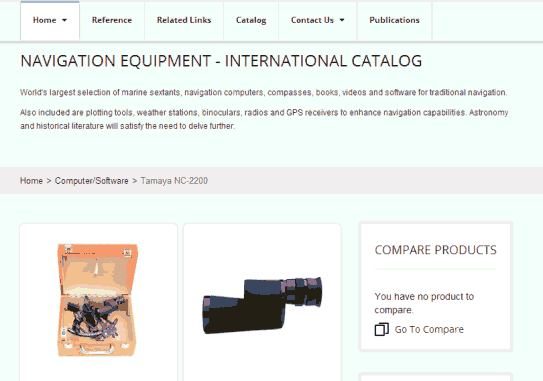
I have experience with other sextants only for limited time. Once I exchanged my SNO-T for Frank's Tamaya for few months. I tested it for a while, the result were comparable to SNO. It had a prizmatic 8x scope, which gives a very good view, comparable to SNO 7x, but it is very heavy in comparison.
Lightness of construction is a thing which I value much about SNO. At the same time it is very rigid. When dong a multiple Lunar observation in an "inconvenient position" (the higher object is on the right hand side) my hand gets tired quickly.
Once I bought on e-bay a very old C. Plath with vernier. I practiced with it for about one year, and then sold it. I did not like it. Reading the veriner was certainly much harder, and took linger time than reading a drum. And it was less accurate than SNO-T. The reason (as far as I can judge) was insufficient rigidity of construction. I made repeated observations with sextant in various positions: straight, upside down, on a side etc.) and they differed sibstantially. The results differed substantially. So my general conclusion was that it was much heavier and flimsier than SNO, and less convenient to use. So I sold it.
I also have some experience with Astra III which belongs to Bill Burchell, a member of this list who used to my neighbor in West Lafayette. Our few observations show that it is quite similar to SNO, except that I like the SNO inverting scope much better. (My SNO also has a 3x Galileo telescope, similar to most of modern sextants, but I never use it. The inverting 7x is by far superior, except one case: when I take observations from a rolling yacht. In this case, I found that the best way is to use no telescope at all; the "zero magnification tube" helps.
Now you are asking about the backlash of the drum screw. This is practically irrelevant, because (following the recommendation of the Soviet manual) I always rotate the drum in one direction: the direction of decrease of the angle. I tried to test for this backlash (the most convenient way to do this is when determining the index error by Sun). And I found no significant backlash (it was 0'.1 or less in all my tests).
Alex.