NavList:
A Community Devoted to the Preservation and Practice of Celestial Navigation and Other Methods of Traditional Wayfinding



From: Frank Reed
Date: 2025 Sep 17, 14:59 -0700
David Pike, you said "15 minutes" became "two hours". Ahh, but next time! :)
I looked at your spreadsheet. Everything looks good. The only thing, of trivial significance, that you missed in your setup is the "inverse" of the radians(...) function. It's degrees(...). Then you don't need your manual pi value.
I find these two functions, degrees() and radians(), annoying to read in spreadsheet formulas, so I decided a few years ago to do away with them in my own spreadsheet projects, and go back a step in spreadsheet "style" for the sake of readability. Whenever I'm doing something with trigonometric functions in it, I start by dropping the formula "=180/pi()" in cell A1. I then edit the "name" of that cell to be "kk" (why kk and not something more helpful, like "dr" maybe? ...it's a long story, going all the way back to my first computer program --FORTRAN on a deck of cards about three inches high). Then when I need to convert some angle x in degrees into radians, it's just x/kk in the formula, or kk*y to bring radians back to degrees. Alternatively, if you can't make a name "stick" on cell A1, you can use the absolute reference, $a$1, instead of kk. Not as pretty, but still better than those long-winded standard functions.
You wrote:
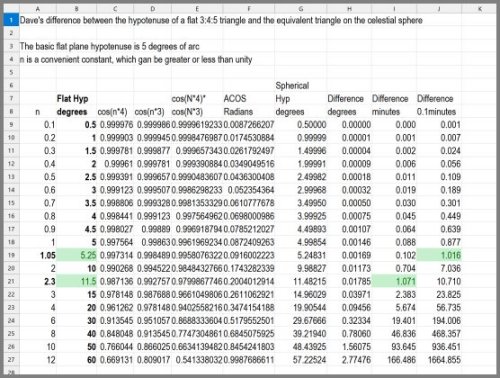
"My results are when the hypotenuse is 5.25 degrees, it’s 0.1 minutes too long. When the hypotenuse is 11.5 degrees, it’s 1 minute of arc too long. This seems way too amazing..."
I didn't check your numbers in detail, but that sounds about right. And that was basically the point that I found interesting and worth highlighting. That "neighborhood" where plane trigonometry is "close enough" and spherical trigonometry is un-necessary is fairly substantial. Of course, it does depend on our choice of that "close enough" level.
Frank Reed
Your spreadsheet again: