NavList:
A Community Devoted to the Preservation and Practice of Celestial Navigation and Other Methods of Traditional Wayfinding
Re: That darned old cocked hat
From: George Huxtable
Date: 2010 Dec 13, 16:20 -0000


From: George Huxtable
Date: 2010 Dec 13, 16:20 -0000
In an attempt to understand better what John Karl has been telling us, I
have just returned to his posting of 8th December, and to his linked file
at-

http://www.navlist.net/imgx/Darned-Old-Cocked-Hat.pdf

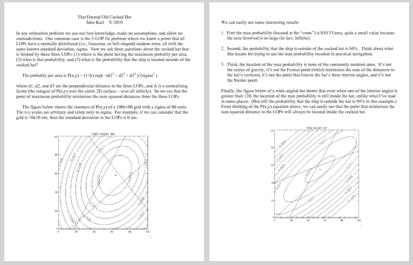
John shows us a cocked hat, without defining its angles, and claims that-

"Second, the probability that the ship is outside the cocked hat is 84%".

I had taken this to be a general statement about all cocked hats,
independent of their geometry, in the same way that my figure of 75% was an
average over all possible cocked hats around ab observer.

But reading on, more carefully this time, I see that he then poses another
example, when one of the interior angles exceeds 120 degrees. Again, John
doesn't tell us about the actual geometry, but now states- "(But still the
probability that the ship is outside the hat is 94% in this example)".

So, the calculated probability varies between one hat-shape and another,
and John's figure of 86% seems to apply only to one particular shape.

So, can we compare that with the 75% prediction at all, which averages over
all conceivable hats? To do so, John would need to arrive at some sort of
global average, over all possible geometries according to some sort of
weighting function. Perhaps he can help to resolve my confusion.

George.

contact George Huxtable, at george{at}hux.me.uk
or at +44 1865 820222 (from UK, 01865 820222)
or at 1 Sandy Lane, Southmoor, Abingdon, Oxon OX13 5HX, UK.
----- Original Message -----
From: "John Karl"
To:
Sent: Wednesday, December 08, 2010 10:22 PM
Subject: [NavList] That darned old cocked hat


That darned old cocked hat seem to keep popping up.  I’ve given this some
thought lately and have computed some examples to investigate questions --
such as where the point of maximum probability is.  I’ve thought for a long
time, and still do, that this is all perhaps rather interesting
academically, but of no practical importance for a navigator who is only
interested in the safety of the ship.  In that case you’re never sure where
you are better than the known random-error distances from each LOP.  (Ocean
racing or armed combat might have different objectives.)

The linked PDF file gives my results and observations.  I’d be glad to run
off other examples if anyone is interested.

JK
----------------------------------------------------------------
NavList message boards and member settings: www.navlist.net/NavList
Members may optionally receive posts by email.
To cancel email delivery, send a message to NoMail[at]navlist.net
----------------------------------------------------------------

File: