NavList:
A Community Devoted to the Preservation and Practice of Celestial Navigation and Other Methods of Traditional Wayfinding

Re: Thin triangle: where is your fix?
From: Martin Caminos
Date: 2025 Dec 8, 18:53 -0800


From: Martin Caminos
Date: 2025 Dec 8, 18:53 -0800
Hello everyone,
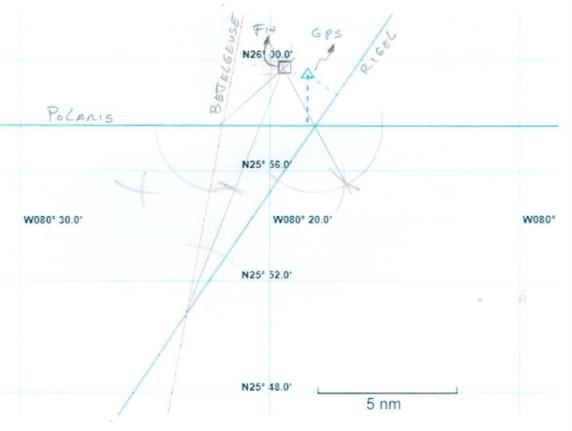
This is an interest discussion, and after seeing so different mathematical explanations, I have decided to try a real example based on three stars available this time of the year on the northern hemisphere, with the idea of recreating a similar triangle like the one Frank used to open the discussion. I picked and shot Polaris, Rigel and Betelgeuse.
The practical experience would also include systematic errors, that were not considered in the original proposal.
I am based in Miami, Florida so there were several stars to shot yesterday evening. Due to the small angular separation between Rigel and Betelgeuse, in normal circumstances I would not have taken both of them, but the LOP's of those two plus the one from Polaris formed a thin triangle quite similar to the one on the discussion.
- I used a A11 bubble sextant
- I took the three sights from the same place, so we do not have to consider neither speed or direction errors between LOP's
- I used my real GPS position as estimated position, so we can easily compare the calculated position.
In my practical experience, this type of thin triangles might produce a calculated position outside the triangle. For that reason, I took the bisectors of heights approach.
One of the rules of the bisectors of heights method, for the calculated position to fall outside the triangle, is that the sum of two consecutive azimuths must be lower than 180 degrees, which is the case on this practical experience.
Also, it is my understanding that this method (when used with at least three LOP's) eliminates the systematic error.
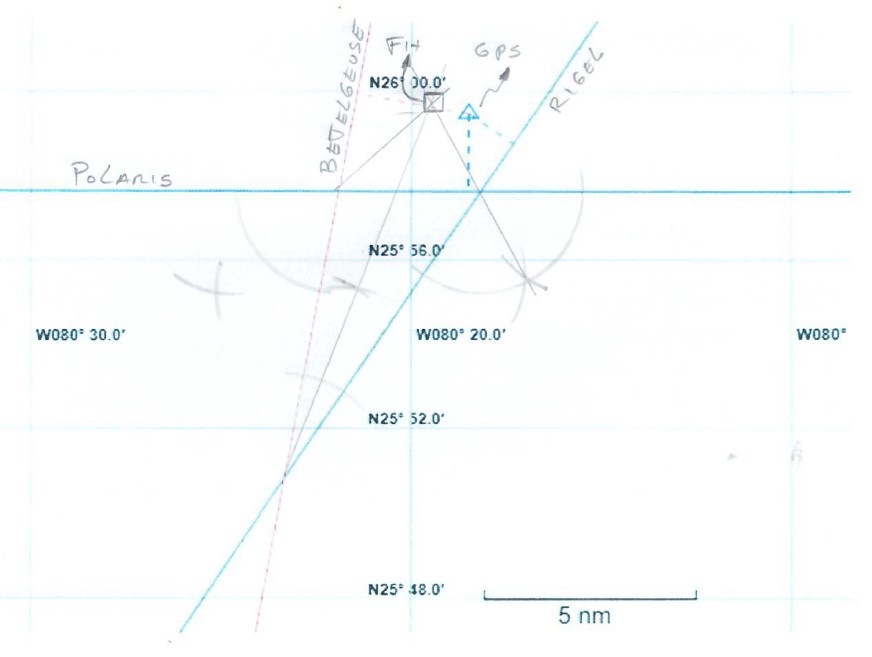
As you can see in the sight reduction attached (generated using Astron software and my manual drawing), the real GPS position (which is also the estimated position) falls outside the triangle, and the calculated position by drawing the bisectors of heights also falls outside, quite close to the GPS position.
What would be reason why in this case, the bisectors of heights gives more accurate results than Frank's formula (y/b = (1/2) b/h) ?
Could anyone else try to resolve this example to confirm the results from any other location ?
Thanks !!
Martin Caminos
File:



File: