NavList:
A Community Devoted to the Preservation and Practice of Celestial Navigation and Other Methods of Traditional Wayfinding



From: Frank Reed
Date: 2025 Dec 10, 08:02 -0800
Robin Stuart,
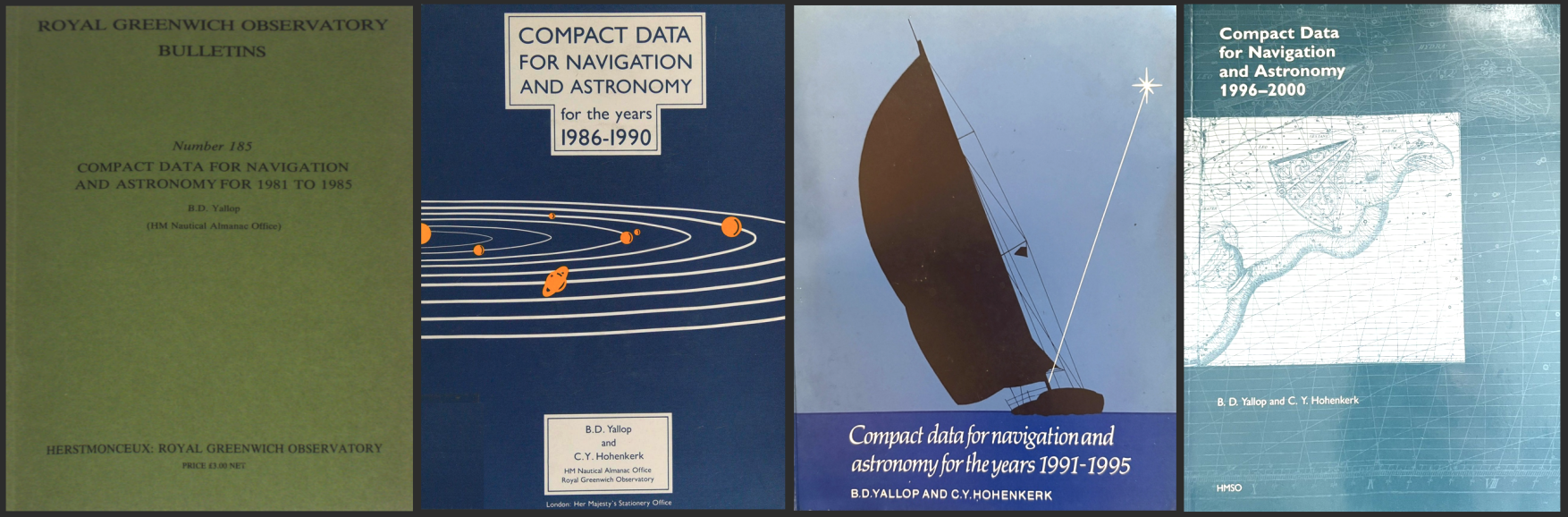
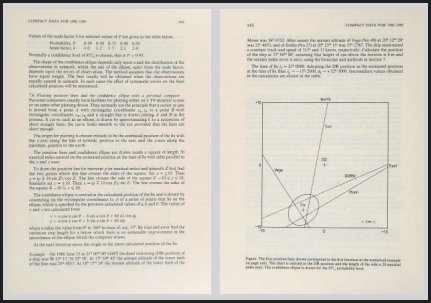
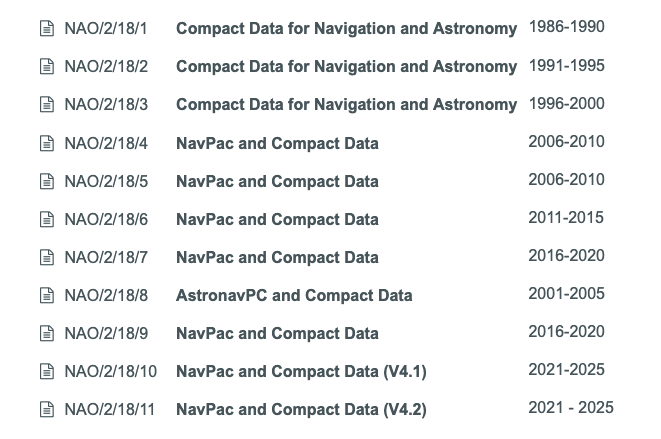
You included a scan (from Lars Bergman?) of the key pages from "Compact Data for Navigation and Astronomy" for 1996-2000 ("Compact Data" for short in this message). It may be interesting for some people reading along to understand just how long this algoritm, this method for determining a fix and an error ellipse, has been availble. The algorithm itself is older, but the earliest edition of "Compact Data" appears to have been published in 1980 with data for the following five years. Updated editions have been published every five years. After 2000 the name was changed and the focus of the product shifted to the included "NavPac" software, which is apparently still published though at a pointless price. I have a hardcopy (of this soft cover book) for 1991-1995. I'm also adding another scan of the relevant pages from the 1986-1990 edition. See attached PDF. Anyone see any significant differences? I looked briefly, and it seems that little has changed. Though the error ellipse was not included, the same least squares algorthm for the position fix has been in the back of every edition of the Nautical Almanac since 1989.
This computation manual, "Compact Data", goes back to the late years of "disco navigation", but it was too obscure to catch on except among programmers, and even we were primarily interested in its methodology for calculating astronomical coordinates of the Sun, Moon, planets, and stars, more than anything else. I remember seeing a copy of the first edition of around 1981, and I recall an elderly navigation enthusiast that I knew being quite excited about the book, and he immediately began programming his HP calculator to use some of its data and methods. Everyone wanted fast tools for accurate astronomical coordinates, but the least squares fix method was mostly ignored.
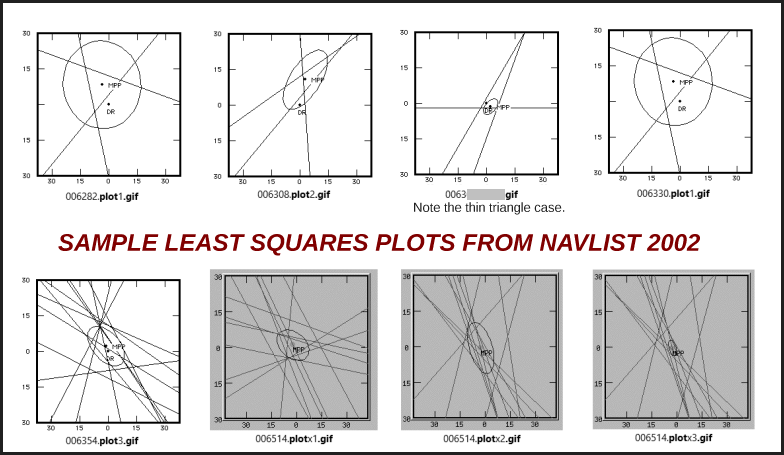
By the time of the early mailing lists that eventually became the NavList community (roughly 25 years ago), the algorithm for finding the least squares fix and error ellipse were well-known but still mostly ignored. Yet some of the very first graphic attachments for NavList messages (examples below from 2002) were experimental cases using those very same algorithms. Navigation enthusiasts were curious and debated the results of these algorithme, but it was still treated as a "black box" tool. I'm including some samples from 2002 NavList below just to remind everyone that, yes, this has been around a long time even for the NavList community!
You'll note in that montage of NavList images from 2002 that I have highlighted a case with a "thin triangle". The 'black box' puts the fix near the middle of the short side of the triangle. There's no explanation or insight from the method. It's an early "app". It does what it does, and you can't really be sure what it's up to. With any luck, some of you can now do better with this key, important case. When you have three LOPs making a thin triangle, the best fix (assuming systematic error is minimal!) falls very close to the center of the short side: the distance above the short side (inside the triangle) is y, and relative to the length of the short side, b, the ratio y/b = (1/2)b/h where h is the height or "long side" of the triangle. Again, this can be separately proved by working the math (a very small calculus problem when you start with a simple isosceles or right triangle), or in the case of a nearly right triangle, you can produce that fix by a rotation of the "rotor" made by the pair of perpendicular LOPs. It's easy, fast, and it makes intuitive sense.
The interval from the first edition of "Compact Data" until those early NavList attachments was 21 years. The interval from those early NavList attachments to now is 23 years! The code caught on early, and most modern apps use the least squares method for the fix and the error ellipse. The black box algorithm is hidden inside the black box app. But navigators —after so many decades— still have no intuitive feel for the results of these calculations and act as if it's all "black magic" ...or "college boy math". The failure here is education. That we can fix.
And a reminder: three-body fixes are important special cases. But we can go beyond three bodies and these triangles either by using the standardized algorithms, like in "Compact Data" or by learning new "intuitive" methods for adding sights.
Frank Reed
Clockwork Mapping / ReedNavigation.com
Conanicut Island USA