NavList:
A Community Devoted to the Preservation and Practice of Celestial Navigation and Other Methods of Traditional Wayfinding



From: Maumus Claverie
Date: 2026 Oct 13, 06:58 -0700
I am investigating an unusual astronomical instrument depicted in an early portrait, provisionally identified by several instrument historians as a nocturnal.
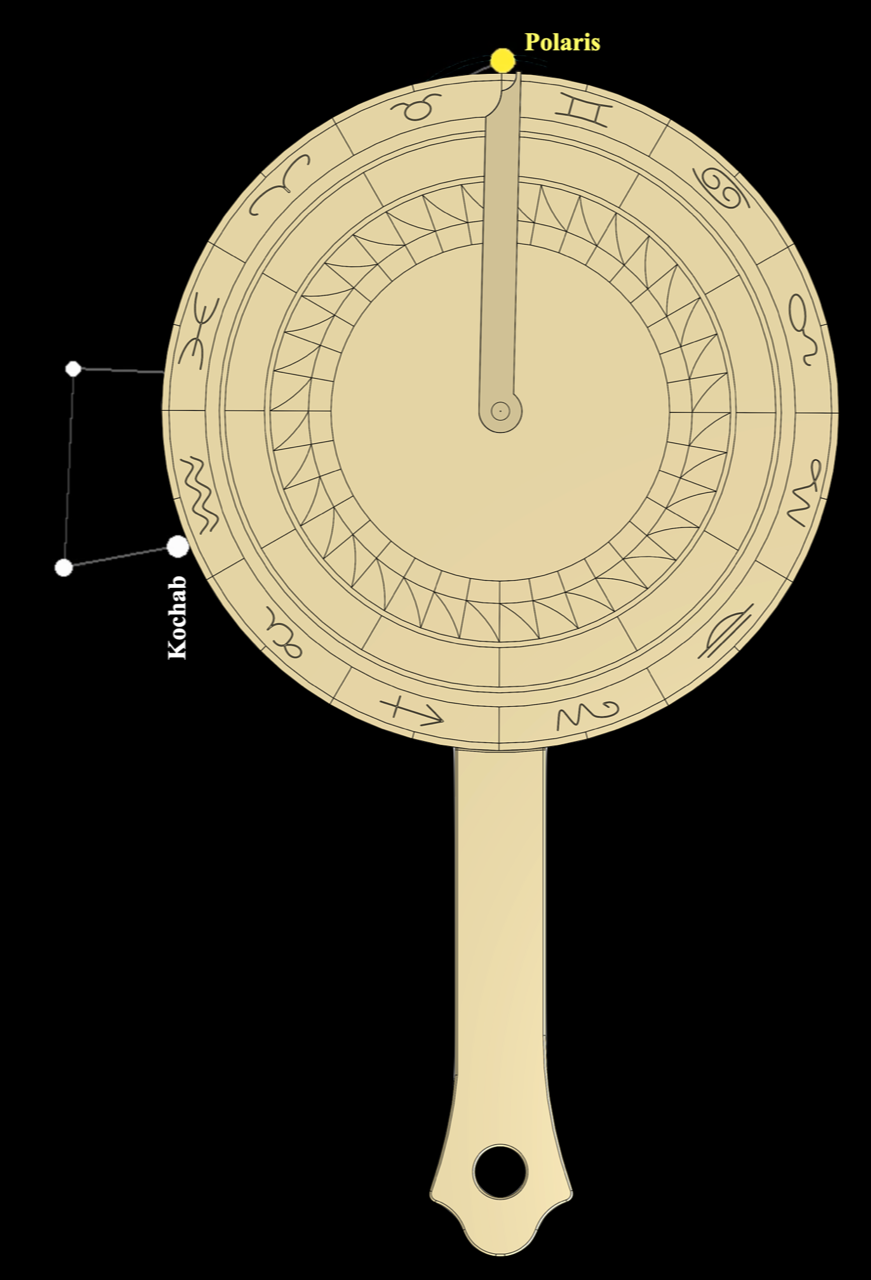
A reconstruction of it is attached.
Unlike conventional nocturnals, it appears to lack a central sighting aperture. It has a rotating index, an engraved geometric lattice, and peripheral divisions.
A CAD reconstruction suggests a possible alternative method of observation:with the disc held vertically, Polaris and Kochab can be positioned tangentially to its outer perimeter, while the rotating index is directed toward Polaris.
Has anyone encountered a surviving instrument, historical illustration, or contemporary description employing a comparable two-star peripheral sighting method.
Practical objections to the proposed arrangement are welcomed, particularly concerning the observer's eye position and whether simultaneous tangency could provide a reliable angular reference.
My interest is primarily in fifteenth- and sixteenth-century navigational instruments, but examples from other periods would also be valuable.
Thank you for any suggestions or references.