NavList:
A Community Devoted to the Preservation and Practice of Celestial Navigation and Other Methods of Traditional Wayfinding



From: Frank Reed
Date: 2026 May 31, 12:08 -0700
On June 8-10 next week there will be good opportunities to see Venus and Jupiter in daylight though you will almost certainly need a telescope to see them.
This will be an "easy" opportunity to see the planets in daylight thanks to a few coincidences. First, this is a conjunction. Jupiter and Venus will be less than two degrees apart with nearly identical ecliptic longitude (closest match near 20:00 UT on 9 June 2026). Second, this event is happening a few days before one of the "zero" dates for the Equation of Time. This is helpful, as we'll see below. Third, at nearly the same time as the ecliptic conjunction of the planets, the Declination of Venus will match the Declination of the Sun. Pure coincidence! This is also helpful since it means Venus will be trailing the Sun on the same exact path of altitude and azimuth across the sky, two hours and forty minutes later.
Observe the position of the Sun at one or more convenient times on June 9. Find spots where the Sun is placed in your local sky near some convenient foreground feature, like the top of a flagpole or utility pole, or the peak of a roof, or a branch of a tree. Your foreground target should be about 10 meters or more away from you. Stand so that the Sun is on the edge of being obscured by your foreground target (sitting atop a flagpole, e.g.). Then mark the position of your feet on the ground at that moment (take a photo of your feet with your phone). Now set an alarm (phone again!) for 2h 35m later. Return to that exact spot, placing your feet in the exact location, and look at the foreground target where you previously saw the Sun. Near perfect timing is 2h 40m after the Sun observation. With binoculars or a small telescope, scan that spot, and you should find Venus. With patience (and maybe better optical aid), you will find Jupiter less than two degrees below Venus.
Easiest setup for this: observe the Sun at your local noon. Since the Equation of Time is near zero on this date, local noon will happen at a UT (GMT) equal to 12:00 plus a number of hours given by your longitude divided by 15°. That will get you out there at the right time, near enough, but you can instead wait for the Sun to be due South at local noon if you have a building or a road or other aligned north/south (due South for mid-northern observers, but due North for observers south of 23.0°N on this date).
Another useful case: observe the Sun in the late afternoon when it is due West (for mid-northern observers). Then come back 2h 40m later to see Venus and Jupiter at that same spot in the sky. By then the Sun will be relatively low in the sky, and you may have better luck seeing Venus and Jupiter with minimal optical aid.
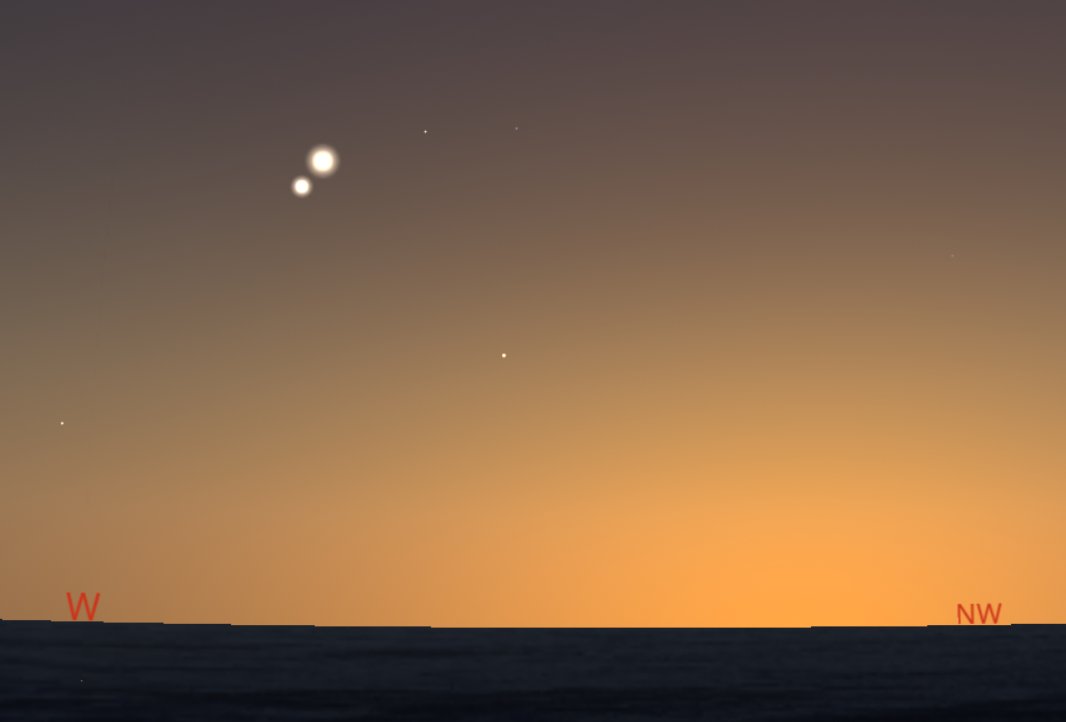
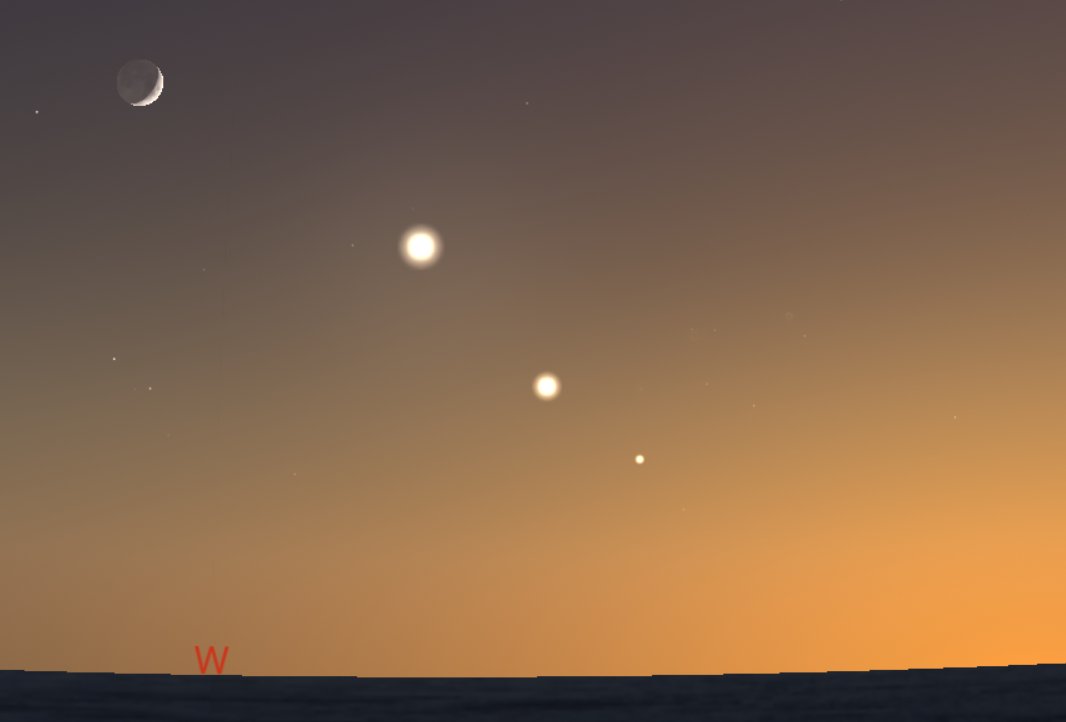
After sunset Jupiter and Venus will be dazzling in the western sky for a few nights centered on June 9. Tell your un-celestial friends! Ten days later, though the separation between Jupiter and Venus will be greater, a thin crescent Moon joins the show. And did I mention the planet Mercury?? Not as obvious as Jupiter, Venus, or the Moon, Mercury will be lined up in the same neat row across the sky, and easy with binoculars or "naked eye". I saw it two days ago.
Finally, if you show this later spectacle, around June 17 to 19, to your un-celestial friends, with a small telescope, near or after sunset, point out the moons of Jupiter, too. And notice that those moons, as well as Venus, our Moon, and Mercury all line up in a roughly straight line which is also pointing at the Sun below the horizon. The Solar System is flat.
Frank Reed
Clockwork Mapping / ReedNavigation.com
Conanicut Island USA