NavList:
A Community Devoted to the Preservation and Practice of Celestial Navigation and Other Methods of Traditional Wayfinding



From: Frank Reed
Date: 2026 Oct 3, 10:46 -0700
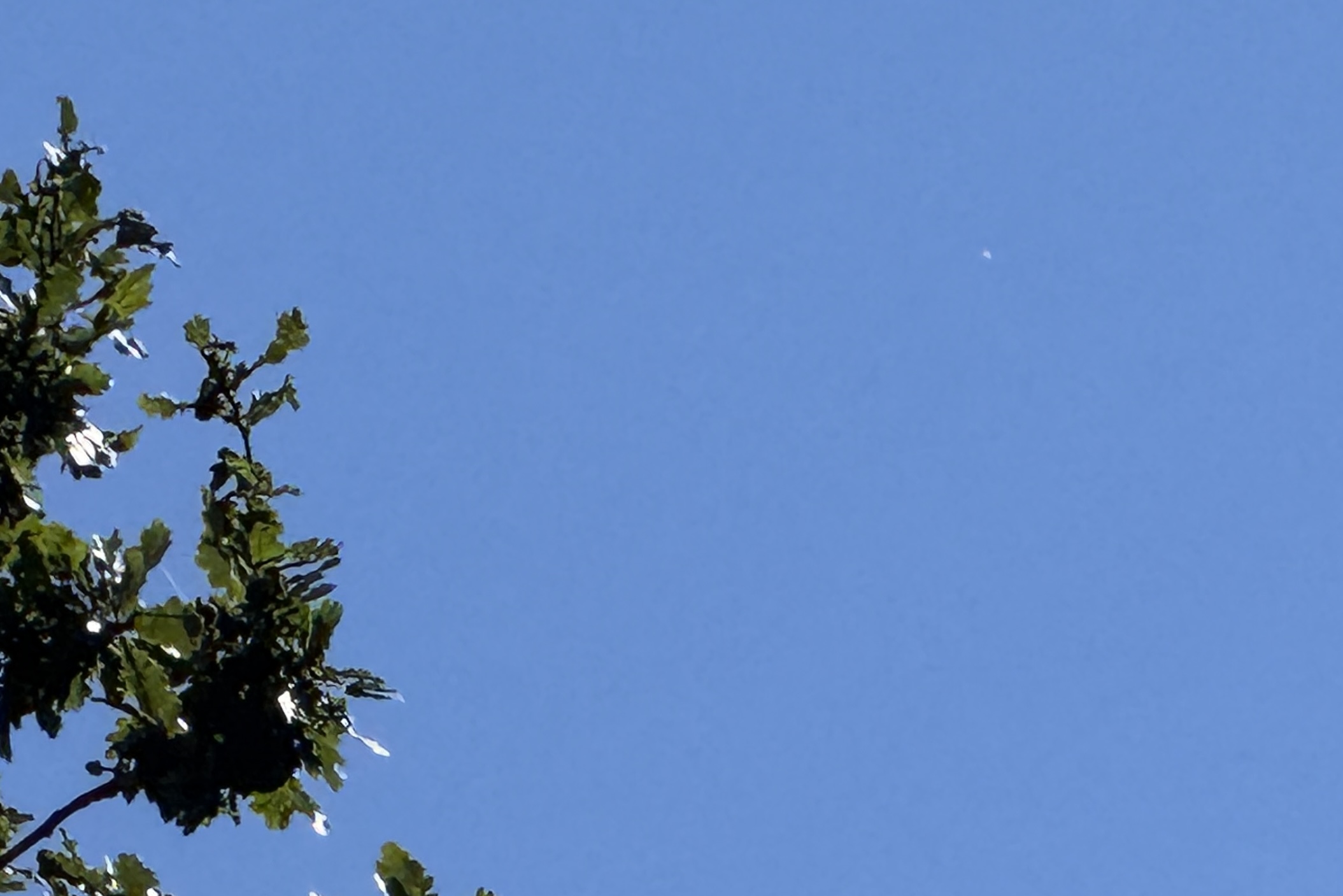
Grabbed a photo of Venus in daylight a few minutes ago (just iPhone with normal zoom, no add-ons or other tricks). Altitude about 26°.
I needed binoculars to find it at first. Took a fair amount of "scanning". I knew from my app it was about 20° below the Sun and 20° left of the Sun. But first I had the binocular focus a little off. Once I spotted it, I thought it might be some aircraft in the stratosphere due to its elongated fuselage. I soon realized I was seeing the crescent phase, even at 7x magnification. A key clue: the elongated visual image was tilted on an axis perpendicular to the direction across the sky to the Sun, just as it should be. :) Of note: for celestial navigation, this is where things can get tricky. Best option is probably tobring the center of that "fuselage" to the horizon...
Venus is no longer easy in evening twilight from mid-northern latitudes. It's setting with the Sun. Those of you in the southern hemisphere, you have better views for a while both in daylight, at much higher apparent altitudes, and also before sunset. For all of us there's only two weeks before it passes inferios conjunction, below the ecliptic (and therefore a long way from the Sun's disk, too). After that, morning star beginning in November.
Frank Reed