NavList:
A Community Devoted to the Preservation and Practice of Celestial Navigation and Other Methods of Traditional Wayfinding


From: David Pike
Date: 2026 Nov 13, 18:40 -0800
[Note from FER: David asked me to post this comment on his behalf]
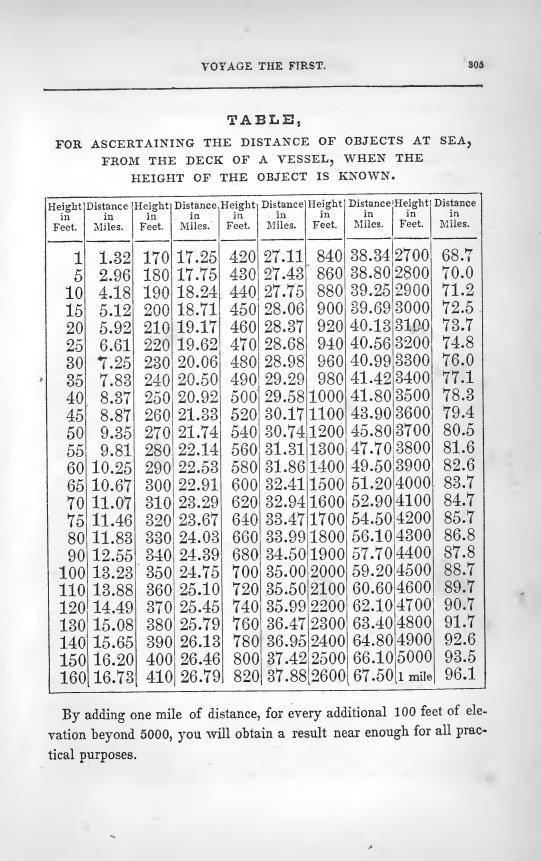
Frank Reed you wrote: “In Hart's "Romance of Yachting" there's a peculiar table for range of visibility. See below (attached). How many problems can you find with this table?”
Here are my comments in no order.
1. The vertical column dividers are all the same thickness and it’s easy to select the wrong range column for a particular height. A thicker line needs to be used to the right of each distance column.
2. The height of observer is not allowed for.
3. Distances do not state if they are sea or land miles
4. No warning is given that at greater distances actual visibility might be less than theoretical visibility except in the clearest conditions.
5. The title of the table is meaningless. The distance of the object can be any distance until it finally disappears over the horizon. The title should be ‘The range at which a light or object first becomes visible over the horizon’.
6. Up to 38 miles distances are given to 0.01 statute miles. That’s 18 yards. Unless you’re firing 17” guns, are you going to need or expect this level of accuracy?
7. The one statute mile per hundred ft of height is true around 5000 ft, but by 6000ft it’s down to 0.86 statute miles.
Reverse engineering.
It appears to me that Hart has taken the ‘Distance of the Sea Horizon’ from a nautical almanac of the time; used ‘height of the distant object ‘in place of ‘height of the observer’; and converted the distances from sea (nautical) to land (statute miles). This then agrees moderately closely with Nories.