NavList:
A Community Devoted to the Preservation and Practice of Celestial Navigation and Other Methods of Traditional Wayfinding


From: Frank Reed
Date: 2026 Jun 27, 12:04 -0700
The small "tablet" on the end of a string calibrated to measure modest altitudes of Polaris in near-equatorial latitudes of the northern Indian Ocean is an object much loved in introductory textbooks on navigation. Unfortunately, it's usually described in a semi-imaginary history passed down through modern textbook authors as "lore". The principle is simple, useful, even trivial, of course, and I teach something similar (a common index card marked up in angles) in some of my celestial navigation workshops. Inexpensive scales can measure angles when held at some fixed distance --on a string or at "arm's length"-- with fair accuracy.
Why is it called a "kamal"? This name, as repeated in western sources, appears to be less than two hundred years old. It was published and began to work its way into broader discussions of navigation starting in 1836.
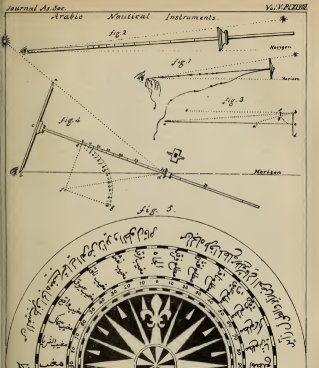
The name "kamal" appears to have been a local name possibly originating in the Maldives. By the 1830s it seems that most local (non-European) navigators were already using British and other western navigation instruments for long-distance "blue water" navigation. See the article below, from the "Journal of the Asiatic Society of Bengal" 1836. Traditional navigation tools were so rare that the author (and editor of the journal), James Prinsep, who was based at Calcutta, had difficulty finding anyone who had even heard of traditional instruments. He finally encountered a navigator from the Maldives who knew of the tablet on a string, and that contact seems to have been the origin of the name kamal.
The article describes several related instruments and also works out some of the math underlying the scaling and calibration of the instruments. It's a fascinating article, even today.
A side note: the wikipedia page on the kamal describes the angular unit in traditional Indian Ocean navigation known as the "issabah" as being equal to the angular width of one finger (at arm's length) and says that this is 1°36'25". Sigh...
Frank Reed