NavList:
A Community Devoted to the Preservation and Practice of Celestial Navigation and Other Methods of Traditional Wayfinding

(no subject)
From: Fred Hebard
Date: 2003 May 18, 16:45 -0400


From: Fred Hebard
Date: 2003 May 18, 16:45 -0400
Doug Royer was so kind as to post the data for his shipboard lunars of
last week.  I looked at them, clearing each one and computing the mean
and standard deviation of the difference in the cleared observed
distance and the computed distance, as well as the difference between
the known time and the time determined from the lunar.  Young's method
for objects of known altitude was used, as outlined by George Huxtable;
thus I ignored Doug's observations of the altitude of the bodies,
computing them from his known position.  For comparison, I show the
same summaries for lunars I have taken on dry land, and two that Arthur
Pearson's took in the Caribbean aboard a small yacht.  For those who
have difficulty reading this in a web browser, paste the table into a
text processor and it should line up properly.

Doug's observation are about as precise as Arthur's and mine as
determined by the standard deviation of arc difference.  However, the
absolute arc difference, and the corresponding time difference, is
quite large, almost 5 minutes of arc.  Interestingly, Doug's arc
difference goes in opposite directions for the Moon, Jupiter
observation as compared to the Moon, Spica observation.  This leads to
very similar time differences for the two observations.  In the Moon,
Jupiter observation, Doug brought Jupiter to the near side of the Moon,
but Spica needed to be brought across the face.  One possibility for
the similarity of this discrepancy is that Doug was not bringing the
objects all the way to the moon, but, rather, leaving a gap.

To determine index error, I use the technique outlined by Bruce Stark,
among others, of measuring the semi-diameter of the sun.  This
technique might sharpen one's skills for lunars, which are measured in
a similar fashion.

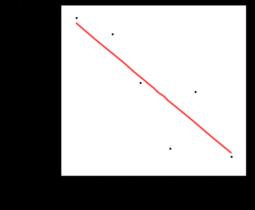
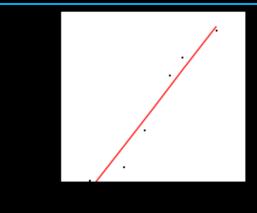
I also have taken the liberty of including two graphs of Doug's data.
I haven't heard any complaints yet about including small binaries like
this.  I hope they come through.  Please let me know if they cause a
problem, and of course, with any comments on the analysis.

Fred


                                  mean      mean      std dev   mean
Objects              n  date     given UT  del arc'  del arc'  del time"

Moon, Jupiter        8  12/27/02  6:36:41  0.884695  0.703781   90.26738
Moon, Aldebaran      7  1/8/03   23:42:01  0.514089  0.830704  -62.1228
Moon, Sun            7  1/11/03  20:33:31  1.219828  1.215593  162.5041
Moon,Sun A. Pearson  7  1/7/03   19:42:07  1.317516  0.404807  169.1811
Moon,Sun A. Pearson  6  1/10/03  18:37:44  1.457861  0.447954  194.242
Moon, Jupiter        5  2/12/03   0:37:40 -0.67918   0.271337   77.6666
Moon, Sun            6  3/9/03   20:40:13  0.981567  1.136952  129.6058
Moon, Jupiter        5  3/10/03   3:53:50  0.693372  0.617291  -83.1301
Moon, Sun            5  3/12/03  22:14:17  1.831421  1.846688  225.4475
Moon, Jupiter        7  4/4/03    1:04:45  4.30333   2.602312 -524.762
Moon, Sun            5  4/5/03   23:04:23  0.760016  0.32473   100.9633
Moon, Jupiter        7  4/6/03    0:20:33  0.209499  0.334972  -25.5961
Moon, Sun            8  4/6/03   18:29:38 -0.03824   0.569998   -5.04673
Moon, Jup D. Royer   6  5/12/03   3:21:47 -5.04648   1.162142 -513.434
Moon, Spica D. Royer 6  5/12/03   5:37:32  4.801561  0.662518 -490.445


Moon, Jupiter, Doug Royer


Moon, Spica, Doug Royer
File:

File: