NavList:
A Community Devoted to the Preservation and Practice of Celestial Navigation and Other Methods of Traditional Wayfinding

Halley's lunar knowledge.
From: George Huxtable
Date: 2007 Nov 24, 21:49 -0000


From: George Huxtable
Date: 2007 Nov 24, 21:49 -0000
In Navlist 3926, under threadname "Ted Gerrard's book", Mike Daly wrore-

"Halley's method can only be as accurate as his lunar position knowledge.
  No one published tables at that time (as Maskelyne did after 1767).
There was the raw data that was coming out of Flamsteed's observations
and other observers that may have been accumulating data.  Newton and
Halley published Flamsteed's data without his permission in 1712 but
what Halley used in the 1699 timeframe I don't know offhand."

=====================================

This note is for anyone interested in Halley's methods.

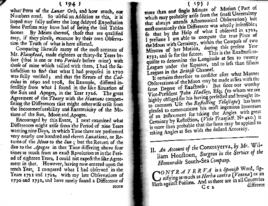
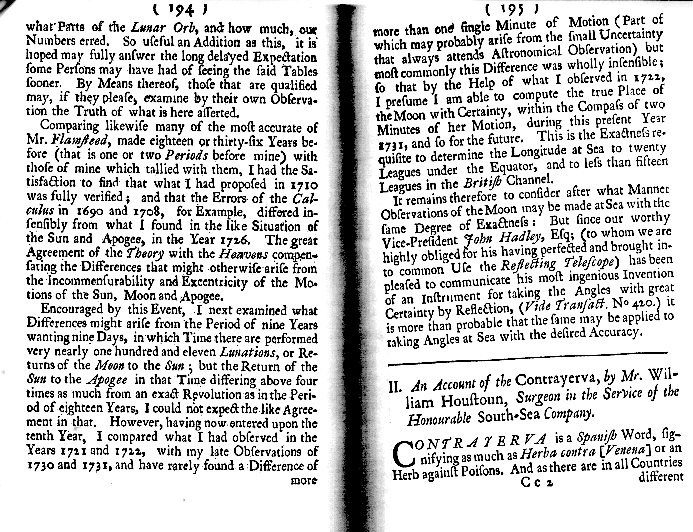
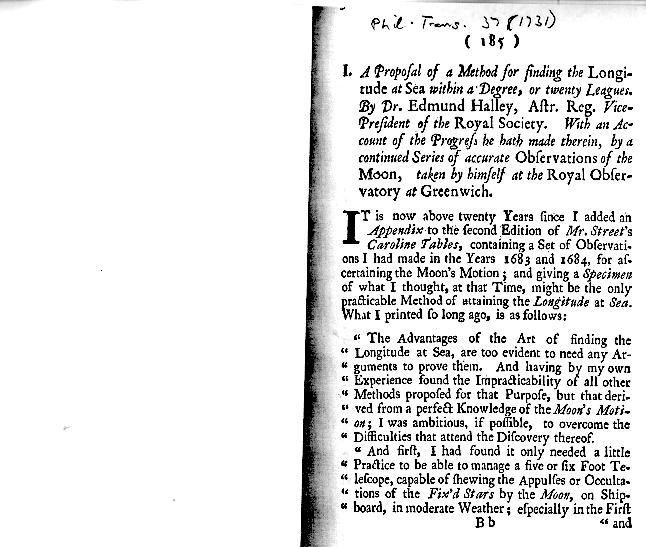
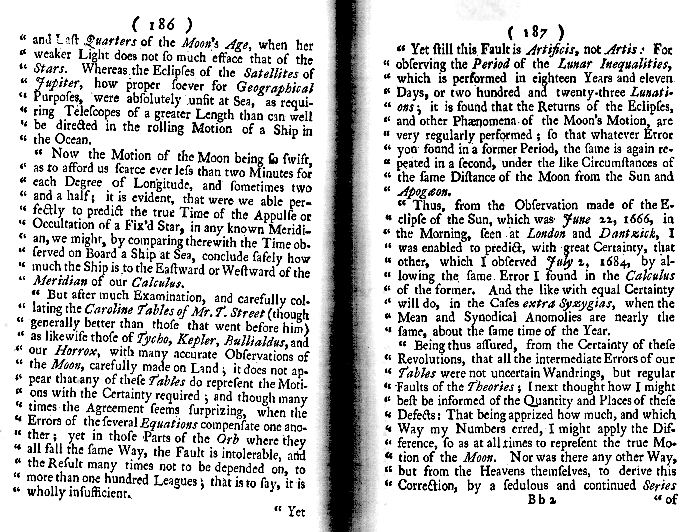
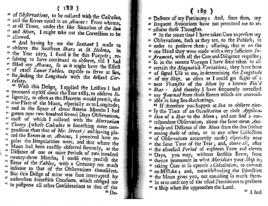
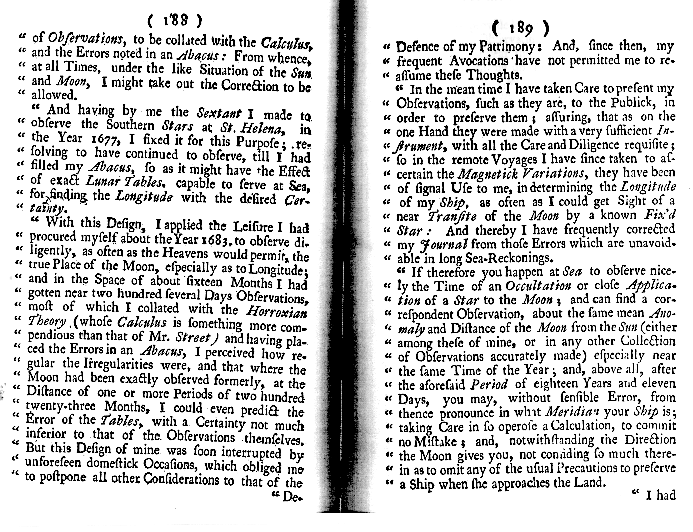
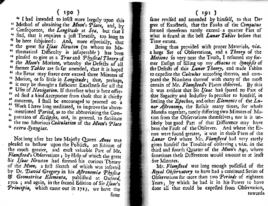
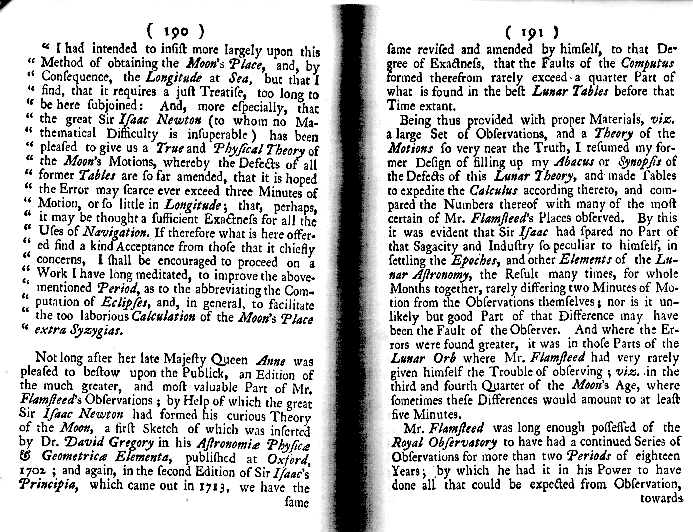
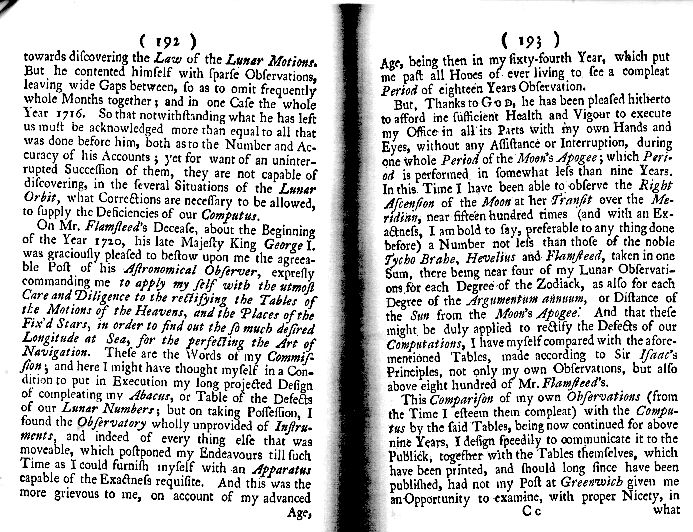
I attach scans of Halley's paper "A proposed method for finding the
longitude at sea ...", which appeared in Philosophical Transactions (of the
Royal Society), vol 37 (1731) pages 185-195, for anyone who wishes to read
Halley in the original. Sorry about the awkwardness of the 2-page-at-a-time
layout, but it's the best I could do. It should allow you to print it out
and reassemble.

Most of the paper is a rewrite of Halley's supplement to Streete's
"Astronomia Carolina" or Caroline Tables, of 1710, with only unimportant
bits omitted.

Halley writes rather clearly, and, for his era, can even spell well. One
puzzle for readers of his paper may be his use of "extra syzygias". Syzygy
(lovely word!) means simply alignment, and the Earth-Moon-Sun syzygies are
when the three line up, either at full Moon or new Moon. So Latin "extra
syzygias" means away from those syzygies, at dates nearer the Moon's
quarters. You might also need to know that the English league is three
nautical miles. And you might like to know that the "domestick
circumstances" that distracted him, were that his father had been murdered!

Halley knew more about the Moon's motion than any of his contemporaries. He
devoted much of his life to observing and predicting it. He didn't need to
rely on the published tables of others, though he gathered what he could. He
had been making his own regular observations of the Moon's position with
respect to the stars, from his home observatory in Islington, London, from
1682 to 84. We don't know what his new bride thought about that...

He tells us that he set up the same astronomical sextant that he had used
earlier in his survey of the southern stars from St. Helena. Alan Cook,
Halley's best biographer, ("Edmond Halley; charting the heavens and the
seas", 1998) tells us that its radius was 5 feet 6 inches, quoting from
Halley's catalogue of Southern stars (1679), and Phil. Trans.vol. 12, no.
141 (1678), 1032-4 (neither of which I've read).

An astronomer's sextant was nothing like a navigator's sextant, of course;
they shared the same name because each had an arc of one-sixth of a circle.
It was intended for measuring the angle between two objects in the sky, just
as in a lunar distance, but often of the angle between two stars, to a
maximum of 60 degrees. It had no mirrors, but two separate telescopes, one
to view each object. Early sextants could swing their frame about on a
ball-joint, and then needed a pair of observers, one to align each
telescope, but Halley's probably had an equatorial mounting, and then one
observer could use it on his own. Cook includes a sketch, supposed to be of
Halley's sextant, made by De L'isle, which to my mind is somewhat suspect,
showing its possible use in measuring altitudes and zenith distances rather
than for angular separations.

His observations for those early years, November 1682 to December 1684, are
recorded in that supplement to the Caroline Tables of 1710. Mostly, they are
of Moon-to-star distances, noted to the nearest 10 sec of arc (sometimes to
5, when it's 15" or 45"). Sometimes just one observation, but more often two
or three repeats, all noted. There are many occultations and appulses noted
as well.

Anyway, the question arises; how did Halley predict Moon positions? There
were indeed tables published of the Moon, contrary to Mike Daly's claim
above, but these were nothing like as precise and detailed as Maskelyne
derived from Mayer in 1767. They dated back to Ptolemy! Intended for
astrologers, rather than astronomers. Halley was aware that the
simple-minded predictions available in his time were highly inaccurate. To
put them right needed an understanding of the dynamics, and Halley was
prepared to leave all that to Newton, whom he was sponsoring. Halley's
approach was a simple, empirical one that's rather easy to understand. He
reasoned as follows-

There are two important cycles in the Moon's motion. One refers to changes
in the plane of its orbit round the Earth; that plane is tilted in space at
about 5 degrees to the ecliptic (the path of the Sun through the stars). The
direction of that tilt changes greatly, from one year to the next, until
after 18 years or so, it's moved round in a complete circle and is tilting
just the way it started. The Greeks, and even the Babylonians before them,
were fully aware of that 18-year cycle.

The other is in the way the Moon's elliptical orbit changes. It comes
closest to Earth (perigee) once a month as it crosses the long-axis of that
orbit. But that long-axis doesn't stay put in space; it's direction shifts a
bit, each month, so that in only 9 years or so, perigee is back to the same
direction in space. After 18 years, it would have rotated twice.

It had been long known that after about 18 years (known as the Saros cycle),
eclipses tended to recur.

Halley worked out that after an interval of 18 years 11 days (which was an
exact number of months), the phase of the Moon would be the same, the
time-of-year would be nearly the same (within 11 days), the tilt of the
orbit and the direction of perigee would all be back where they were before.
So whatever those corrections to the simple predictions were (whether or not
they were understood) they would be almost exactly the same 18 years 11 days
later.

So as long as the Moon position had been carefully measured, 18 years and 11
days before, Halley could work out what the necessary corrections (they were
called "equations") were, and make predictions accordingly, without needing
to understand all that dynamics. There were snags, of course. Those repeat
periods were not exactly 2 to 1. And there were other influences at work,
with a different timescale; particularly the resonance between the giant
planets Jupiter and Saturn.

Halley was 65 when he took over at Greenwich as Astronomer-Royal, which had
been stripped bare of its instruments by Flamsteed's widow, so he had
nothing to observe with until a year later. Nevertheless, he confidently set
up to observe a full 18-year cycle of the Moon's motions, and completed it
before his death in 1742, at 85! His paper, attached, was an interim halfway
report, after the first 9 years, when one perigee cycle had been completed.

What is of particular interest to us is the use of Moon predictions in
obtaining longitudes for Halley's two Atlantic voyages. He is rather
reticent about that matter in his Journal, usually stating only the date,
the star used for appulse, and the resulting longitude.

On his first voyage, telescope lunars (not lunar distances)  were observed
between 15 February and  12 June 1699, and after a spell in London London,
on his second voyage, between 5 December 1699 and 30 July 1700. The crucial
period, 18 years and 11 days before then, would be from early February 1681
to mid July 1682, and for that period, Halley would need Moon observations,
to make predictions for those later lunars. That was before the start of his
recorded Islington observations, in November 1682. So was Halley
systematically observing Moon positions, with respect to the stars, in that
earlier period? We don't know, but it looks a bit doubtful.

At the relevant time, Halley was travelling in Europe, with his friend
Robert Nelson. At the start of the period in question, Halley was in Paris,
with Cassini, observing the comet of that year (not Halley's) amongst other
matters. In mid- May, they were  travelling South, toward Rome; Halley
measuring latitudes as they went with an 18-inch quadrant. Did he carry a
telescope as well; all he would need, with the portable quadrant, for
observing Moon appulses and occultations? We know little about what he did
in Rome.

By 15 Jan 1682 he was back in Paris, and by 24 Jan he had returned, via
Holland, to London. With all that travel, it was not a good time for making
systematic observations of the Moon. So the question remains open; what were
Halley's Moon predictions, used to determine longitudes for his Atlantic
voyages, based on? Any ideas?

George.

contact George Huxtable at george@huxtable.u-net.com
or at +44 1865 820222 (from UK, 01865 820222)
or at 1 Sandy Lane, Southmoor, Abingdon, Oxon OX13 5HX, UK.


--~--~---------~--~----~------------~-------~--~----~
To post to this group, send email to NavList@navlist.net
To , send email to NavList-@navlist.net
-~----------~----~----~----~------~----~------~--~---
File:

File:
File:
File:
File:
File: