NavList:
A Community Devoted to the Preservation and Practice of Celestial Navigation and Other Methods of Traditional Wayfinding

Re: Not exactly Navigation, but close...
From: Frank Reed
Date: 2008 Apr 23, 23:48 -0400


From: Frank Reed
Date: 2008 Apr 23, 23:48 -0400
Alex wrote:
"Shortly speaking, scientists DO monitor these bodies. The bodies that
are on the "possible collision course". They are able to detect any such
body many years in advance. If a really dangerous one is detected this will
be known, and we DO have means to deflect it. The main problem is how much
in advance we know. Modern technology (and moderate expenses) permit to
detect really dangerous bodies about 20 years in advance."

There's no 'a priori' guarantee that such objects will be detected twenty
years in advance. The big unknown is long-period comets which are frequently
discovered as little as one year before they reach the vicinity of the
Earth's orbit. It's not clear what fraction of the impact risk comes from
long-period comets. It may be as little as 5%. It might be as much as 30%.

And you wrote:
"There are technologies with permit us to deal with this danger in 20 years
period (including research and development)."

Yes. And one of the best solutions, which many people find surprising, is
"paint it white". Dust a dangerous asteroid with white powder and it will
reflect much more light increasing the sunlight pressure on it and
deflecting the asteroid over the course of a few years.

And you wrote:
"Anyway, my personal conclusion from this lecture was that "there is nothing
to worry about" in comparison to the REAL dangers facing us. Roughly
speaking, the risk of a serious collision (in terms of the number of victims
and the chance that this happens) is comparable to the risk of a major
earthquake). All this is negligible in comparison with the real dangers we
face:-("

You should look into it yourself. The risk is certainly not negligible --but
it has, of course, been exaggerated frequently in the media.

The really nice thing about this particular source of mass destruction is
that the risk can be SIGNIFICANTLY reduced, and indeed has already been
significantly reduced (in the past dozen years or so), by spending a
relatively small amount of money. All we have to do is compile an almanac
 --an almanac of all of the exceedingly faint asteroids that happen to be in
orbits near the Earth's orbit.

Twenty years ago, the risk of an asteroid impact had to be treated as a
purely statistical risk, very similar to the risk of an earthquake. But
asteroids are different. We can predict their motion once they are
catalogued. It's as good as having a train schedule. During the 1990s and
continuing today, the United States, in particular, has spent a little money
funding these cataloguing projects. The number of known asteroids with
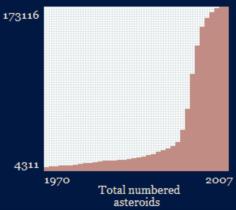
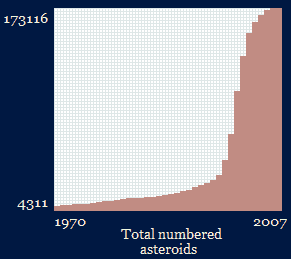
well-determined orbits has exploded in recent years (see attached graphic).
The statistical risk has thus been reduced by a factor of five or better.

There are still uncertainties regarding impact risk. There's the long-period
comet problem that I mentioned above. And even among the ordinary asteroids,
no one is even considering the enormous task of tracking "city-buster"
objects (like the one believed to be responsible for the Tunguska event in
1908). There are far too many. In the case of those objects, we simply have
to count on the fact that the population of the Earth, as well as our
valuable assets, are highly concentrated geographically so, even though we
may get one impact every century or two, the expected casualties and costs
are "acceptable".

Attachment shows the count of "numbered asteroids" versus time. The numbered
asteroids are objects with well-determined orbits. The number of asteroids
with partially determined orbits is around a million. The majority have been
discovered in the past ten years. Almost all of these were discovered by
projects intended to reduce the impact risk.

 -FER


--~--~---------~--~----~------------~-------~--~----~
Navigation List archive: www.navlist.net
To post, email NavList@navlist.net
To , email NavList-@navlist.net
-~----------~----~----~----~------~----~------~--~---
File: