NavList:
A Community Devoted to the Preservation and Practice of Celestial Navigation and Other Methods of Traditional Wayfinding

Re: An "alternative" sextant?
From: George Huxtable
Date: 2008 Dec 20, 16:35 -0000


From: George Huxtable
Date: 2008 Dec 20, 16:35 -0000
Thanks to Scott Owen for taking an interest in my proposal for an
"alternative" sextant design. He has made some perceptive comments, but  I
need to explain the layout more clearly. Then I would like to hear what he
has to say next.

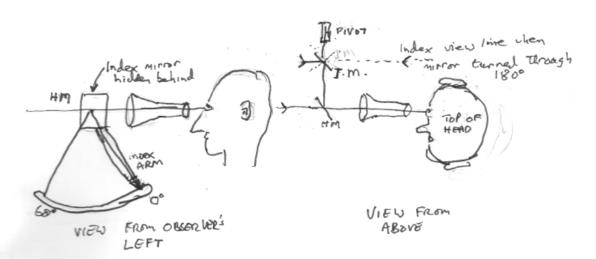
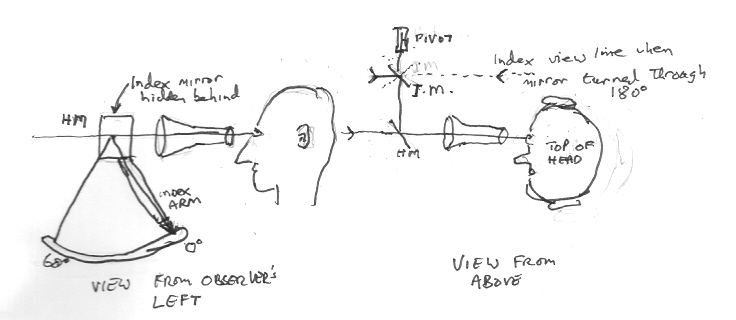
Drawing is not my forte, as will be clear from the attached sketch, which is
intended to show the mirror positions and light paths, nothing more. HM and
IM are horizon and index mirrors. There's a view from the observer's left
and another from above his head.

With this layout, a standard sextant arc would allow measurement only to
60º. If the mechanism was redesigned to allow the platform of the index
mirror to be rotated by 180º about the pivot axis, as shown by dotted lines,
then viewing the horizon astern would be possible.


I will copy my original message, with Scott's interpolations marked between
parallel lines,  and with my own responses shown between {{ brackets like
this}} with the letters G and S to clarify what's from me and what's from
Scott.


G
The following idea may be a bit daft, and if it is I hope Navlist
members will identify the snags and point them out.
============================================================
S
I'm not sure I can point out any snags but I have some questions and
comments, so your patience is requested.
============================================================
G
What follows is an alternative way to reassemble the basic components of
a sextant in a new geometry, which will give it different
characteristics from the standard instrument. It's difficult to
illustrate the notion without making a perspective drawing (at which I
am hopelessly bad), so instead I'll try to paint a word-picture.
================================================================
S
With my feeble brain a flat side view would be very helpful and a
perspective view wouldn't necessarily be needed.

================================================================
G
{{I will try}}

G
Start by taking a normal sextant and rebuild it. I'm not asking you to
demolish your favourite instrument; just imagine it in your head, which
is all I've done, so far.

The angling of the index mirror has to change. Instead of its plane
being perpendicular to the frame, it's now placed at exactly 45º to the
frame, in such a way that incoming light from the observed body is now
reflected to travel along the pivot line of the arm. The horizon mirror
is shifted and fixed to a bracket that places it so that the pivot line
passes through its centre, with a few centimetres spacing between the
two mirrors. The horizon mirror, too, is angled by exactly 45º to the
plane of the frame (about a vertical axis). In that way light from the
observed body, travelling along the pivot line, is reflected into the
telescope, which is aligned to point to the horizon as normal, and
relocated to centralise the horizon mirror in its view. The horizon
mirror is half silvered, as normal, so the observer sees, in the
telescope, a direct view of the horizon and superimposed, a view of the
celestial object, reflected via both mirrors, just as with a
sextant.
=================================================================
S
The "shifting" of the horizon mirror position and the resulting location
of the telescope seems to be the tricky part, at least for me anyway.
If I understand this correctly, and I don't think that I do, you want to
relocate the horizon mirror to a position a few centimeters "down" and
connected to the index arm then relocate shades and move the telescope
"back".  Is that right? or are you envisioning something like a dual
frame with the index arm "inside"?

=================================================================
G
{{No, not a bit like that. Stick with a perfectly standard sextant frame.
Look at the instrument face-on, with its frame vertical. Your eye is placed
on the pivot axis, looking horizontally. The index mirror is fixed to the
index arm, centred on its pivot axis, bur now twisted through 45º so that it
reflects the incoming light towards your eye, along the horizontal line of
that pivot axis. Undo the horizon mirror from its normal location and move
it bodily up and right, a few centimetres , so that it intercepts your view
(along the pivot axis) of the index mirror and it, too, is centred on the
pivot axis. Of course, it has to be moved towards your eye a bit, away from
the frame, so that the mirrors don't clash, and space is left to insert the
index shades between the mirrors, and maybe a bit extra. It's now fixed to
the frame there on a new bracket; re-angled so the horizon mirror is now in
a vertical plane, but twisted about a vertical axis until its exactly 45º
from the plane of the frame. Now light travelling along the pivot axis is
reflected by the horizon mirror towards the right, still travelling
horizontally. That's where you relocate the telescope, to collect that
light, and also, as normal, to have a view of the horizon, alongside or
through the horizon glass. So now, the telescope is in the same horizontal
plane as the pivot axis: not below it, as before..

When the index is set to zero, so that light from the horizon is seen in
both views, all light paths are in a horizontal plane, and light travelling
via the index mirror undergoes two 90º bends. to end up pointing in its
original direction. If the index arm, with its mirror, could be rotated
clockwise through 90º (for which a redesigned arc and frame would be
required), then light from a zenith star would be reflected into a
horizontal direction. And so on.}}

G
The essential feature of the Hadley 2-mirror invention is then retained;
that after two reflections the image of the observed body will shift
about in the view exactly the same as the direct view does, so that
motion of the instrument in a seaway will not cause any relative motion
between the two views.
============================================
S
No problem there you still have two mirrors.
============================================
G
At the index-arm position when the two mirrors become exactly parallel,
it should be at its zero mark, and the two images of any distant object
should coincide, allowing checking of index zero-error as with the usual
sextant.
===========================================================
S
I'm guessing the "zero mark" to be near the 3 or 4 o'clock position, is
that right? or is it near the 6 o'clock position?
===========================================================
G
{{just as with a normal sextant, the direction of the index arm and the
arc-zero, when measuring zero, can be placed, together, at any arbitrary
direction. For convenience, it's conventional to put the zero starting-point
of the scale somewhere near the observer's chin, but it might well be
elsewhere.}}

G
However, there's another "essential" feature of the normal sextant that
will no longer apply. Normally, as the angle of the index mirror
changes, the deflection of light changes by twice that angle. But that
law is only true when all light paths are kept in the same plane. With
this alternative instrument, the light paths are in very different
planes (except at the zero-check position), such that the deflection of
light becomes equal to, not double, the angling of the mirrors. (If
anyone can offer disproof, please do so).
============================================================

S
This seems correct to me but are the light paths in different planes
because you  "tilted" the mirrors 45deg or because you've moved the
horizon mirror and tilted it 45deg too?  Sorry if some of these
questions seem rather stupid, but as this experiment intrigues me, the
only way for me to fully understand is to ask some stupid questions.
============================================================

G
{{Fair enough. It should all suddenly fall into place when the penny drops,
because it's quite a simple picture}}
G
Horizon shades will be placed in the direct view line through the
horizon glass, as usual. Index shades will go into the space between the
two mirrors.

What would be the consequences of the new geometry? Most obvious is the
doubling of the angular motion of the arm, that's called for to achieve
the same angular range. A standard sextant frame, only 60º wide, would
only be able to measure up to 60º of arc, not 120º as with the standard
sextant, so this would clearly be insufficient. The arc length would
need to be doubled to subtend 120º, or even (for reasons we will see)
180º. That would lead to a large, clumsy instrument, except for the
following...
============================================================
S
With an arc of 180degs doesn't the index arm get in the way of the
telescopic observation as the index arm approaches the horizontal position?
=============================================================

G
{{I don't see why. If the index arm starts to obscure the outer fringes of
incoming light, the index mirror can be spaced away from it, a bit.
What I've explained, so far (with the aim of simplifying the picture) is how
you could adapt an existing sextant to cope with the different geometry, but
that world work only for angles up to 60º. For angles greater than 60º,
however, and especially if extending the range to180º, mechanical redesign
becomes necessary, and with the arc-radius reduced to (say) 9cm, radical
redesign become very possible, indeed rather easy. For example, there could
be advantages in having the drum and worm in a fixed position on the frame,
and the (semicircular) arc moving with (or replacing) the index arm, rather
than vice versa as at present.}}

G
Because each measured degree now corresponds to a whole degree subtended
on the engraved arc, and not half a degree as with the normal sextant,
the degree markings, and the teeth of the rack,  now become twice as far
apart as they were. Or, to put it another way, the same precision as
before can now be achieved by halving the radius of the arc. So a
standard sextant with a 60º arc and 18cm. radius could be replaced by
one of 180º arc and 9 cm radius, which would be no less compact.

There would be a few advantages, if only minor ones. Because each mirror
always reflects through 90º, there's no shrinkage in the view to a
letter-box shape, as you get with a sextant at large angles. That
implies you could use the instrument right up to 180º, wall-to-wall
between horizons. to measure dip, as long as one proviso has been met.
That is, that the sideways displacement between the two sight-lines is
enough to allow incoming light from astern to miss the ear of even the
most jug-eared navigator. That's why there has to be a certain minimum
spacing between the two mirrors.
==================================================================
S
Won't this "sideways displacement" between the sight lines affect the
split horizon mirror and effectively shrink the sight picture "side to
side"?

==================================================================
G
{{No. Or at least, I don't see why it would.}}


G
Another minor advantage would be that there's no vertical offset between
the two view-lines, only a horizontal one instead. So instead of calling
for a distant horizon to zero-check on, to avoid parallax errors, that
job could be done with something quite close-up. Also, it means the same
instrument could be used for on-land close-up angular measurements for
surveying purposes, which presently call for a theodolite because of the
parallax error that offset causes..

I haven't yet discovered any major drawbacks to such a redesign, and
hope that Navlist members will point out any there may be. For example,
is its calibration unduly sensitive to the exactness of those 45º
twists? Drawbacks there must be, I presume, if in all the years of
sextant development, nobody has tried, or even proposed, such an
alternative construction. Perhaps someone has, that I'm unaware of;
dicovered the snags, and dropped the notion.
============================================================
S
I've no more questions but that picture sure would come in handy about
now.  --Scott
============================================================

G
{{I'll do my best to attach something that makes more sense}}

G
The era of the sextant has been and gone; now is not the moment to be
proposing a redesign, and that's not what I am doing. I am just asking
the question; could sextants have been made in quite a different way,
and if not, why not?

If no serious objections emerge to the principles of what's been
suggested, I can proceed to the practical details of how such a
very-different instrument might have been constructed, which I've been
pondering on, a bit.

George.


contact George Huxtable, at  george@hux.me.uk
or at +44 1865 820222 (from UK, 01865 820222)
or at 1 Sandy Lane, Southmoor, Abingdon, Oxon OX13 5HX, UK.

--~--~---------~--~----~------------~-------~--~----~
Navigation List archive: www.navlist.net
To post, email NavList@navlist.net
To , email NavList-@navlist.net
-~----------~----~----~----~------~----~------~--~---
File: