NavList:
A Community Devoted to the Preservation and Practice of Celestial Navigation and Other Methods of Traditional Wayfinding

Re: Precision of sextant observations: taken from How many chronometers?
From: Bill Morris
Date: 2009 May 9, 22:24 -0700


From: Bill Morris
Date: 2009 May 9, 22:24 -0700
George Huxtable wrote:

"We need to consider the instruments that were being used, throughout the
lunar era, which would all be Vernier sextants, not micrometer types. I have
such a sextant, which I haven't taken to sea. Using it on land, my old eyes
have great difficulty, even with a good magnifier, perceiving which of three
adjacent lines on the Vernier makes the best fit, even with really good
illumination."

and Henry wrote of "well calibrated modern instruments"

For most of the period in which lunars were used in earnest, no calibration
service was available, at least in Britain. Kew Observatory offered the
service from about 1870 onwards, but calibrated only 49 instruments in the
first twenty years. Even then, the precision of the calibration could be no
better than the precision of the instrument itself. For example, an
instrument divided to 20 seconds could be calibrated only to that precision.

George has mentioned the difficulty in actually reading the verniers and since
it is a rainy day, I have done some simple investigations to try to get some
idea of the reliability of a vernier reading in ideal circumstances. The
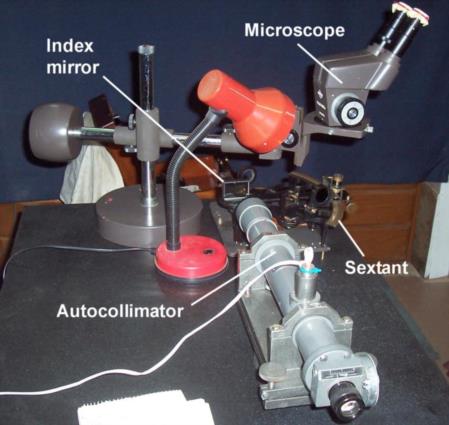
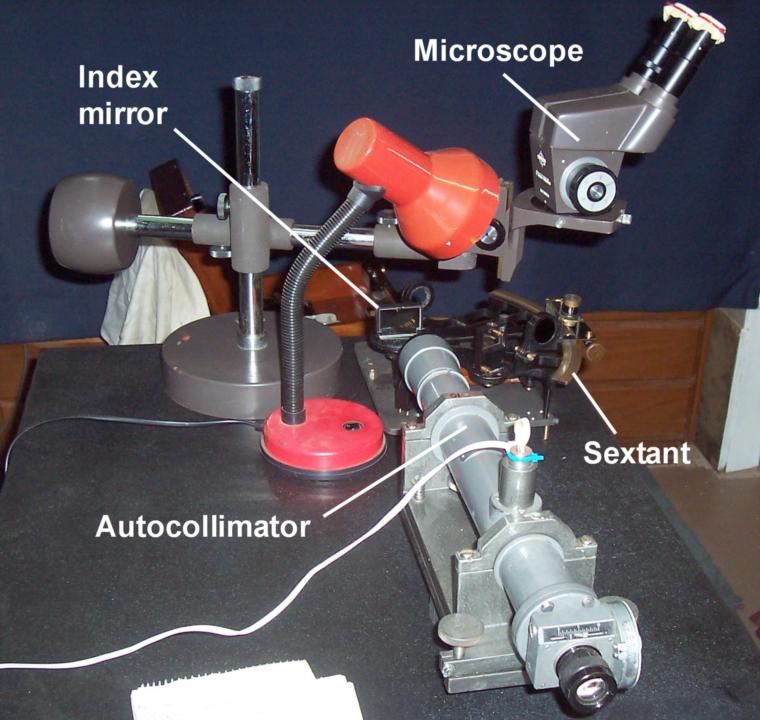
set-up is as shown in the attachment. The sextant sits on a levelling jig on
a surface table and an autocollimator is directed at the index mirror so that
its axis is at right angles to the mirror. A lamp and low power stereo
microscope are used to read the vernier at a magnification of x 20.

I won't go into many details of the autocollimator. It is an optical device
that can measure the deviation of a projected light ray when it is reflected
back from a mirror. The instrument shown has a least division of 0.2 seconds
and in expert hands is said to be reliable to 0.3 seconds, given a high class
reflector and perfect viewing conditions. For my own part, I can very easily
detect a deviation of 3 seconds and I think it is safe to say that the
repeatability of a single reading would always fall inside that range.

Using first the microscope and then the magnifier provided with the instrument
to set the vernier, I reset the sextant thirty times to the same reading and
took readings with the autocollimator on the index mirror to study the amount
of variation. The results do not depend on mirror adjustments, bearing
eccentricity and the like, though both instruments had recently been fully
stripped down, rebuilt and adjusted.

The first sextant was a ladder framed one by Brandis and Son Inc. The "Inc"
places it after 1916 and its serial number places its manufacturing date
around the First World War. The vernier is divided to 20 seconds and its
simple plano-convex magnifier has a focal length of 25 mm, giving a nominal
magnification of x 10.

The second sextant was a high class ladder frame sextant by Hughes and Son and
has a 1920 calibration certificate from the National Physical Laboratory
revealing no error across its range. The vernier is divided to 10 seconds and
the Ramsden magnifier magnifies x 7.5. Like the Brandis, its graduations are
sharp and easy to read, but are rather finer than the former's.

The standard deviation is a measure of dispersion of the results around the
mean and in this context we can expect them to be normally distributed. That
is to say, about 68 percent of results will be found within 1 SD each side of
the mean  and 95 percent within 1.96 SDs each side of the mean. In the
results that follow, I give the rounded 68 and 95 percent ranges when using
the magnifier provided.

                SD Microscope    SD Magnifier  2 SD range  3.92 x SD range
                                                  (68%)       (95%)

Brandis             4                 11.7         23          46

Hughes              4.3                4.0          8          16

The better results of the Hughes instrument are probably due to the finer
graduations and possibly also to the colour correction and flatter field of
the magnifier. While repeatability of setting is not quite the same as
accuracy of reading of the vernier, this little experiment does give us some
insight into the latter. We could perhaps agree that when the Hughes sextant
is set to a nominal reading, there is a seventy percent chance that the
setting lies within 10 seconds of that chosen reading, and a ninety-five
percent chance that it lies within 16 seconds of it.

When it comes to reading a sextant, the results are critically dependent on
obtaining a correct index error. As I have shown in a previous post,
whichever method of ascertaining index error is used, there is quite a lot of
dispersion
of the results, at least with micrometer instruments. For my own part, I doubt
that observations could be reliably and consistently made to within 10
arcseconds.

Bill Morris
Pukenui
New Zealand

--~--~---------~--~----~------------~-------~--~----~
Navigation List archive: www.navlist.net
To post, email NavList@navlist.net
To , email NavList-@navlist.net
-~----------~----~----~----~------~----~------~--~---
File: