NavList:
A Community Devoted to the Preservation and Practice of Celestial Navigation and Other Methods of Traditional Wayfinding



From: Antoine Couëtte
Date: 2025 May 7, 02:59 -0700
Thanks, Frank, for your comprehensive reply. I will elaborate on some of the subjects it raises.
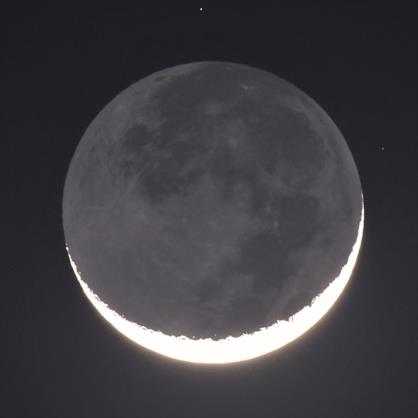
(1) - Photo computed vs. measured Stars to Limb angular separations
From PHOenix PHOtographer's actual position at N33°24.1'/W111°56.3' , I decided to estimate the quality of our "Stars to Moon Limb angular separations" measurements.
Hence I am here-after computing the Stars refracted distances to the Moon Limb in order to compare them with our measured values.
Computed results here-after take in account both:
- WGS84 Latitude and Longitude (as given by Frank, i.e. N33°24.1'/W111°56.3')
- Refracted Augmented SD's accurately computed along each individual star/Moon Center local direction from vertical (Standard Atmosphere)
- Altitude above WGS84. For the latter value, and starting from 330 m AMSL, and with local Geoid at 30 m under WGS84 (as per EGM2008), I am therefore using +300m as the Observer's altitude above WGS84 0m level.
With "my" Moon Data Ephemeris accurate to +/- 4" (at 4σ) , such computed refracted distances are about the closest computed approximation to real world I can reach. These resulting computed angular separations are then deemed accurate to +/- 0.06' (at 2σ). Claiming anything "better" would be useless here since the Moon Limb irregularities (mountains) start becoming significant at this 4" level.
(1.1) - For HD 29364B as Brighter star (used by Antoine only)
Near Limb :5.846' (vs. 5.801' measured) / Far Limb : -38.904' (Modris did not use this star)
(1.2) - For HD 29364A as Brighter Star
Near Limb : 5.808' (vs. 5.801' measured) / Far Limb : -38.897' ( vs. Modris' -38.87')
We both measure HD 29364A with remarkable accuracy : within better than 0.05'
(1.3) - For HIP 21482 used as Fainter Star
Near Limb : 3.432' (vs. 3.315' measured) / Far Limb : -36.578' ( vs. Modris' -36.47')
We both measure HIP 21482 with some uncertainty close to 0.1', which still remains good and quite acceptable in our environment.
And finally, HIP 21482 (HD 29364A) was a better pick than HD 29364B which was my first choice.
This nicely transitions us towards the following topic "double star" topic.
(2) - Double stars
As regards double stars I am happy to observe that computing the brighter component ephemeris from its catalog data always bring us to less than 6" from the Center of light observed. This adequately solves our requirements since an achieved 6" accuracy is a solid benchmark for CelNav.
"Sufficient for Government purposes ..." and I could close the subject then.
But ... I still do not feel quite comfortable with double stars either.
The former FK4 Catalog did publish elements for the components applicable to some of the stars gravity centers, which just by itself was already sufficient for CelNav purposes. This also permitted to accurately compute the individual component positions in the sky.
I have not studied how the "new catalogs" - HIP and GAIA - permit the accurate computation of each individual component - as locally affected by its companion gravity - since they seem to publish only their "standard" individual data in which the relative distance and angular motions/rotations do not seem to be addressed at all. This lack of information - as I see it - is to necessarily degrade sooner or later the quality and reliability of the ensuing numerical computations over the centuries, if not the decades or maybe even the years.
Hence, if I can get some insight here, anybody bringing light here is most welcome.
(3) - New navigation techniques ?
As earlier addressed, and as also Modris seems to refer to, using satellites distances from the stars can give excellent accuracy positioning on Earth.
As Modris also indicates: you do seem, Frank, to have other ideas in your bag, no ?
Let me mull over it ...
And again, thanks for everything,
Kermit