NavList:
A Community Devoted to the Preservation and Practice of Celestial Navigation and Other Methods of Traditional Wayfinding



From: Antoine Couëtte
Date: 2025 May 7, 09:35 -0700
Regarding §(3) and § (4) of my last post on the approach to tackle this problem numerically (no Stellarium or the like), [almost] all has already been said actually.
It simply (!) boils down to : 3 angles yield 3 angles
To solve for Longitude, Latitude and UT of the Photo, we need 3 different angles, almost as independent and unrelated from one another as possible and free from any vertical error in the Photo as well.
I would then use :
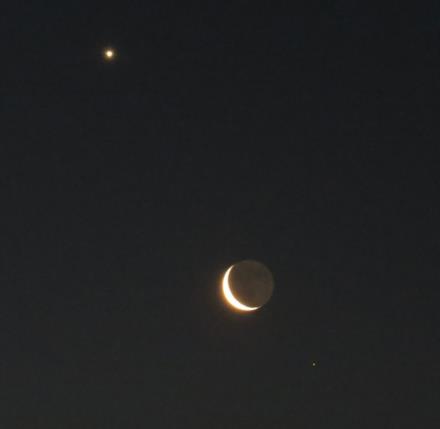
(1) - The angular separation between Saturn-Moon and Saturn-Venus, which we have already measured at 6°. This angular difference is [almost] unaffected by any error on the vertical.
(2) - Some fastest moving distance on the picture: subject to confirmation, it is probably the Saturn-Moon Near Limb distance, again [almost] unaffected by any vertical tilt.
(3) - As for one extra angle, that's where the Moon's Horns could come to play.
(3.a) - I would probably go for the angular separation between the Saturn-Venus line and the extended line joining the Moon's Horns. Again subject to confirmation, that's probably also the fastest moving angle involving the horns.
(3.b) - Or maybe the Line joining Saturn - bottom horn and Saturn-Venus ?
(3.c) - Or even as suggested by Frank the distance between the extended line joining the Moon's Horns and one of the planets (which one ?) ?
Thus we should have at hand three different measured quantities reasonably expected to be sufficiently "independent".
This should work to yield both Photo UT and Lat / Lon position.
Your advice here Frank ?
Kermit
PS : Definitely no time for me to continue work on this one.