NavList:
A Community Devoted to the Preservation and Practice of Celestial Navigation and Other Methods of Traditional Wayfinding



From: Antoine Couëtte
Date: 2025 May 5, 03:47 -0700
Thanks to you Frank for your last comments.
(1) - In particular you wrote "I think you'll find it's not as bad as it first appears. "
I had surmised that this problem would show some significant dilution of position for 2 different reasons:
(1.1) - The stars being so close, they would generate "cones" very close to one another hence producing in turn an ill defined position: this is a wrong reasoning on my behalf and I need to take it back.
In fact, the closeness of both stars is not the #1 factor for the position dilution, which - actually - might be acceptable, as Modris does show it here and as will be addressed further down this current post.
(1.2) - The "cones" are not really locally vertical, and this is THE main factor, since the Moon Altitude is close to 20°. We both fully agree here. And the inverse of sine 20°, i.e. 2.9, is a good indicator of the dilution of position.
(2) - I earlier indicated that "an almost similar problem has already been submitted on NavList" in early 2022 by Dave Walden" .
First : Excellent insight from yours in the whole paragraph following "That was an occultation puzzle ....".
Second : This current problem can indeed be solved exactly like this former occultation puzzle by our dear Dave Walden.
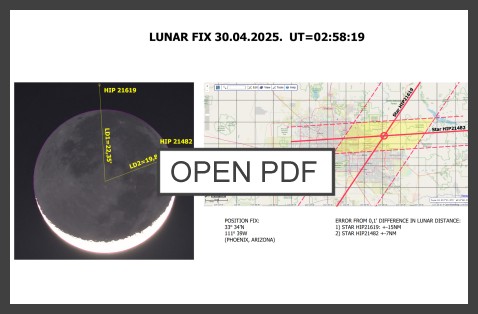
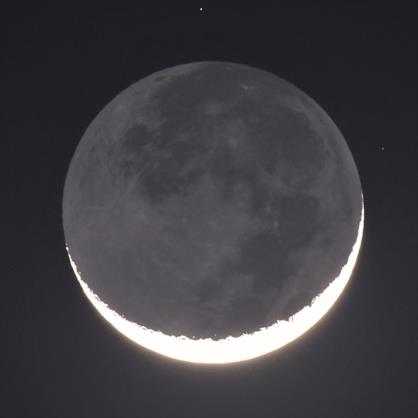
(2.1) - Starting from my printed copy of the photo, I am measuring horizontally: Moon Augmented SD at 40mm, brighter star at 14 mm from the Limb and fainter one at 8 mm from the Limb.
The Moon augmented SD is equal to 16.574' and can be measured horizontally on the picture. It provides us with a reasonable photo scaling factor. Then with the data hereabove, I am measuring the Brighter star at 5.801' from the Limb and the fainter star 3.315' from the Limb.
(2.2) - If we treat this current problem exactly as an occultation, then :
2.2.1 - For the Brighter star, if we assume that the Moon has a fictitious Augmented semi-diameter equal to 1.35 time its current one - (40 + 14) / 40 = 1.35 - then the brighter star would be just grazing this fictitious Moon.
2.2.2 - For the Fainter star, if we assume that the Moon has a different fictitious Augmented semi-diameter equal to 1.20 time its current one - (40 + 8) / 40 = 1.20 - then the fainter star would be just grazing this fictitious Moon, again a different Moon that the one applicable to just the brighter star.
3 - Position Fix and error analysis
From the full method depicted here, with both fictitious Moons defined just here-above, I am obtaining the following results :
3.1 - Photographer's position :
30 Apr 2025, 02:58:19 UT / 02:59:28.2 TT / N33°21.0' / W 112°07.5'
This position takes in account standard refraction and height at 0m above the WGS84 Ellipsoid. Star Ephemeris accurate to much better than 1" and Moon Ephemeris accurate to /-4".
Biggest star unknown comes from the Brighter star, a double star. I did use the earlier referenced Hipparcos star slightly different from yours, Frank, since "my chosen" Hipparcos star is probably closer (at less than 5") from the Light Gravity center of both stars.
3.2 - Error budget :
With "BSLD" standing for Brighter Star Limb Distance , and "FSLD" standing for "Fainter Star Limb Distance :
∂BSLD/∂Lat = -0.036' / 10' Lat ∂BSLD/∂Lon = -0.046' / 10' Lon
∂FSLD/∂Lat = +0.145' / 10' Lat ∂FSLD/∂Lon = -0.064' / 10' Lon
If no error in the data immediately hereabove - which I trust as reliable - and if no error in their processing - which I trust as less reliable since I have not reopened my Engineering courses books on this specific chapter:
- An error of 0.1' in the brighter star limb distance yields an error in distance almost reaching up to 35 NM
- An error of 0.1' in the fainter star distance yields an error in distance close to up to 17 NM.
These numbers show more pessimistic than the ones given by Modris.
4 - Extra-check with both stars not grazing the real Moon.
From computed position in 3.1 here above, with the "Real Moon", I am computing :
Brighter star limb distance at 5.802' (vs. 5.801' observed) and Fainter star limb distance at 3.314' (vs. 3.315' observed).
This extra-check indicates that - in this example at least - the advocated fictitious Moons method works extremely well.
5 - Final wish ...
Please be so kind, Frank, as to publish the actual Observer's position.
Kermit